



i have not seen Christopher Nolan’s The Odyssey. i do not plan to.
why? well, not in the least because the well on my old regal cinemas gift card has run dry, and that shit is expensive. but regardless of any personal reasons, i can confess that i am writing about it because i am fascinated by the dialogue around the film and what it exposes, purposefully or not, about america today. in particular, the controversy over casting Helen of Troy as Lupita Nyong'o. and to a lesser extent, other parts of the rest of the cast — biracial Zendaya as Athena, Columbian-American John Leguizamo as Eumaeus, British-Indian Himesh Patel as Eurylochus, and so on and so forth.
the question at the front of everyone’s mind: does it matter?
this itself is a bit of a misdirection, though; it very obviously matters. if we were to remake The Color Purple or Boyz n the Hood with an all-white cast, it would make waves. that, besides being hilarious, would have a public response (and a response from the american left-wing in particular) that would be rather different.
it very obviously matters: every couple of months, america rides on the culture-war carousel, upsetting itself with debates on whether or not replacing specific characters who were not originally envisioned as black — or, at the least, originally widely perceived as white — with actors who are not white. like a fat man on the escalator, we can’t seem to move past it.
so — does it matter? asked and answered, your honor.
the question is less “does it matter,” and moreso when does it matter? and what does the answer to that question say about us?
the answer to that first bit is that patently obvious projections of american racial anxieties on-screen are immediately apparent to many audiences, american and non-american alike. it’s like a pathological liar who won’t believe anyone else.
many viewers are likely to recognize the move to cast Nyong’o for what it is — subversive, in the sense that is designed to “subvert” expectations. there’s nothing inherently bad about that; this itch is very common in art, especially so in modern cinema, with modern influences seeking to craft a compelling and novel take on a nearly three-thousand-year-old story.
so it makes the subsequent decision here by Nolan in press junkets, by the studio in promotion, and by some currents of american media to pretend as if there is nothing odd or controversial about depicting Helen of Troy as a black woman, and the accusation that you’re actually “weird” (to use choice 2024 election lingo) if you choose to even notice this choice, all the more strange on its face. would you not want to advertise the fact that you are doing something bold, and brag about it? why would you want to pretend it’s not there?
this reaction, though, makes perfect sense once you appreciate the idiosyncrasies of 21st century american racial neuroticism and insecurity (which are quickly being exported abroad — hell, Nolan isn’t even american himself).
The Odyssey (2026), for better or for worse, is a very obvious reflection of an american, free-trade, globalized world. it is one of a people in a post-9/11 america, living in the New American Empire™, where we make nothing and have everything, where New York contains approximately zero twin towers and approximately one muslim mayor, and we accept it all without blinking.
“the Lebanese man who makes my cappuccino in Little Italy with Columbian coffee beans asked me to rate his shop five stars, using my cellphone produced in Taiwan, while an African man with a heavy pidgin accent argued with a tourist group from China trying to haggle down the prices on his stall of used books. what does it matter if my greek hero story includes people from Africa, South America, and Southeast Asia?”
simultaneously, though, such a telling conflicts with what we’ve already been taught about america and how we’re better than our historical analogues. the cast, if it were set in midtown Manhattan, makes perfect sense, but it is one that is extremely jarring if we are to treat it as mythology taking place in the ancient Mediterranean as Nolan asks us to do, land of stupid and violent conquest-minded proto-colonial europeans.
the message of Nolan’s Odyssey, implicit or explicit, chafes against everything the average modern american is taught about diversity, equity, and inclusion; are we better than our predecessors for being more global, more accepting, and more open-minded, or were they already standing where we stood? are we standing on the shoulders of giants, or midgets?
the two positions are unreconcilable. you can’t simply dismiss the audience as stupid for questioning such obvious cognitive dissonance, or when they do it with any other insanely insecure piece of 21st century american artwork.

lost amidst all of this controversy, you cannot help but feel bad for the greeks. first, for the fact that they have not done anything important since 500 AD; second, for the 2009 sovereign debt crisis (seems like a decade of austerity would suck ass, no?); third, for having their mythology trampled all over by ugly americans. perhaps the only consolation for them amongst the whole thing is that the studio did not cast Addison Rae in a role like Penelope.
but not because their mythology is particularly sacred.
had Nolan set out to radically reimagine The Odyssey — transplanted to another culture, another era, another mythology — there likely would not be a mouse stirring. audiences understand adaptation. Shakespeare has been moved into the realm of LA gang warfare, Japanese feudal politics, high schools, and outer space. the point of an adaptation is precisely that it announces itself as one.
it’s fairly easy, it’s cool, and has also produced some of the greatest works of art known to man — East of Eden, West Side Story, Ulysses, and even the Matrix are all solid examples. There are strict adaptations - think 1996’s Romeo and Juliet, with guns and street gangs — and looser ones, like West Side Story, which leans on Shakespeare’s Romeo & Juliet heavily, but doesn’t come right out and say it. The result, though, is the same: a great story.
the Odyssey, having been around longer than Jesus, has no shortage of adaptations and retellings. Orson Welles even put on a production in 1950s Paris adapting the tale of the Odyssey to the setting of 18th century Haiti with — guess what? — a black Helen.
i cannot tell you whether or not it is the “right” choice to cast a black woman as Helen of Troy. what i can tell you is that casting a black woman as Helen of Troy will quite easily set off cognitive dissonance in an audience that is not prepared for it.
in Welles’ adaption, there would already be the expectation that the story would be different and the characters would be different; specifically, that the cast would be filled by black actors playing black, post-revolution Haitian characters. no one is surprised that Helen of Port-au-Prince is black.
in Nolan’s depiction, though, it gets the noggin joggin’: it is anachronistic, unfamiliar, and not at all expected, except maybe in a very specific audience (smug american progressives who want to feel good about themselves — “why yes, i did expect the most beautiful woman in the world to be depicted as black”). because of this disconnect, many viewers will seek to fill in the blanks — they will rationalize Nolan’s choice any number of different ways and come to their own conclusions about the decision, including interpreting it as modern partisan political theater (something which they may be correct about).
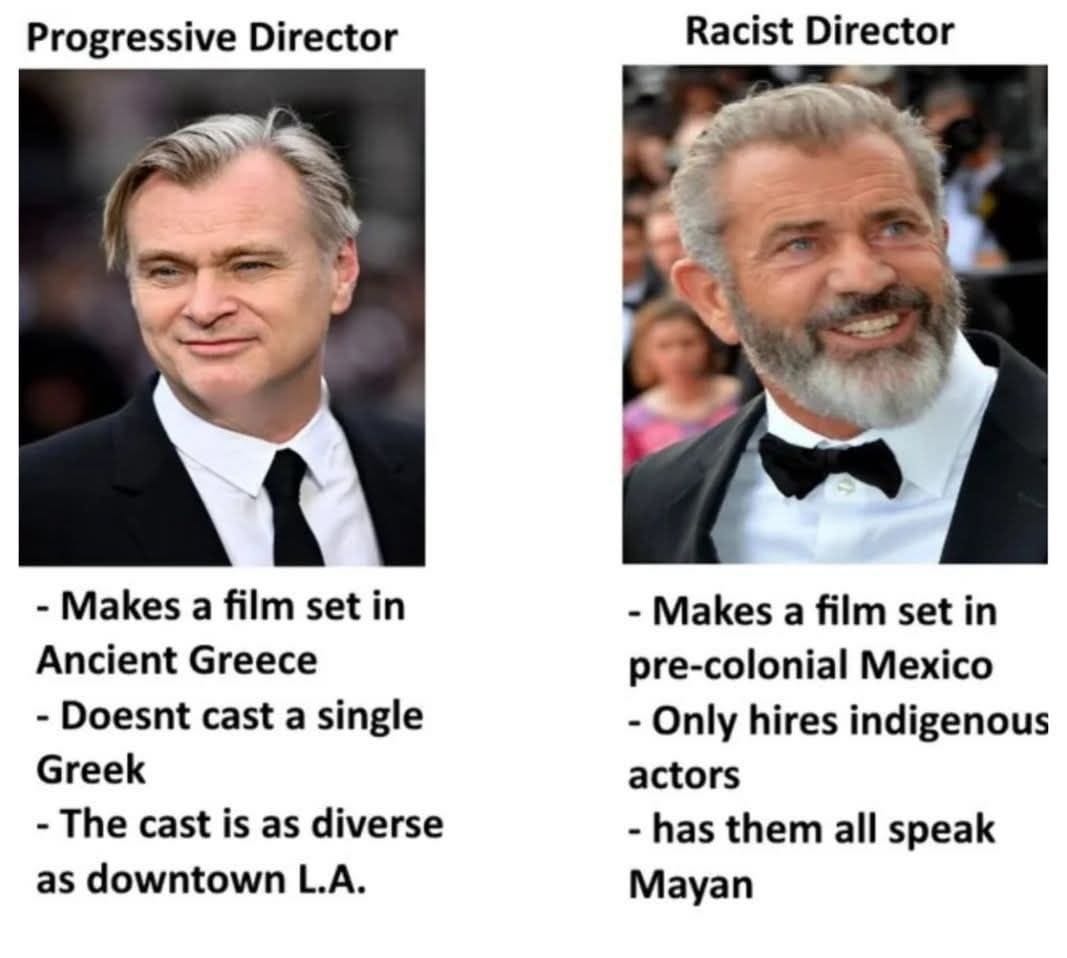
regardless, the response to much of the dissonance hovering around the Odyssey (2026), seems to be: “what??? you don’t believe a black woman can be beautiful???”
this is, again, misdirection, and it’s lame.
Helen is famous not because she is beautiful in the abstract, but because she belongs to a particular story, told by a particular civilization, about itself. she is famous because she belongs to a story that western civilization has been telling itself for nearly three thousand years. when people picture Helen, they are not imagining Lupita Nyong’o, or Diane Kruger, or any particular actress; they’re unconsciously pulling from a giant communal filing cabinet stuffed with paintings, sculptures, operas, poems, schoolbooks, and old sword-and-sandal epics. you are free to kick over that filing cabinet if you think you’ve got a better idea. artists have been doing exactly that forever. just don’t stand there afterwards insisting nothing fell on the floor.
it’s seemingly uncomfortable for many Americans to admit that artistic choices carry cultural meaning. instead, Nolan’s film appears to present itself as “the” Odyssey while quietly asking its audience to reinterpret the visual world through contemporary American assumptions about identity. instead, the audience is encouraged to believe there is nothing to interpret at all — that Helen is simply Helen, and anyone who notices otherwise is introducing politics where none exist. that ambiguity is where the friction comes from.
but audiences do not consume art that way. they look for intention; they always have. every costume, every accent, every camera angle communicates something. casting is no different. the insistence that this particular decision is somehow exempt from interpretation is precisely what makes people suspicious of it.
the irony is that this impulse is itself deeply american. we increasingly treat our own assumptions as universal ones. diversity, race, representation — these are very pressing questions inside contemporary american society. but they are not necessarily pressing everywhere; they are not the organizing principles of every civilization that has ever existed.
in this sense, the Odyssey's bronze-age greek tale becomes another mirror in which modern america admires its own reflection.
and it is here that the ugly american rears its head.
the american in a foreign land who does not care about the local culture, who does not care about the local history, who cannot seem to see past the world with himself and his problems as the focal point. much of the same attitude seems to persist in the discourse around The Odyssey (2026).
“who cares?” the ugly american cries. “it’s just a movie.”
except it never is.
nobody believes The Passion of the Christ is just a movie. nobody believes Schindler’s List is just a movie. nobody believes a remake of The Color Purple starring an all-white cast would be “just a movie.” we understand instinctively that artistic choices communicate values. somehow, though, we’re expected to suspend that instinct here.
“why are you making it about race?”
because somebody already did; audiences are merely trying to understand why.
really, it is not Nolan’s fault when american cultural neuroticisms bleed on his artwork; but as its director he is ultimately responsible for putting out Hollywood attitudes on an ancient story that cares nothing for it. at its core, his depiction of Helen is disconcerting to many viewers because it is a bold display of the age-old american weakness: the ugly american.
the ugly american is now too lazy to even travel abroad anymore, it seems; he has elevated himself to the point of bringing the world to him, by way of remaking foreign myths and history until they resemble his own neighborhood, and then, having bulldozed the foreignness out of them, he turns around and asks why anyone would object. perhaps that is the real american empire: not conquering the world, but making the world look like america until there is nowhere left to go.