


Introduction
This is no neat little bedtime story. It’s a sprawling, sordid tale about the CIA and the gritty port city of Marseille - a place that smelled of salt, sweat, and secrets in the aftermath of World War II. The spooks in Langley, alongside their French counterparts at the SDECE, struck a devil’s bargain with Corsican gangsters, who funneled heroin through the veins of Europe and across the Atlantic, all in the name of crushing the Communist labor unions that threatened to tighten their grip on the Old Port. This was more than simple union-busting; it was a geopolitical chess game played on a board slick with opium and blood. Marseille became a happy hub for the transatlantic heroin trade, a toxic side effect of supporting the Truman administration’s Marshall Plan and French military escapades in Indochina. And the result? A roaring heroin pipeline straight to America, leaving a legacy of addiction and chaos in its wake. Predictable, tragic, and as American as apple pie.
To Live and Die in Marseille
In 1945, the attitude held by many Europeans was not as joyous as one might expect. While much of Europe was celebrating its recent liberation from the grasp of Nazi Germany, it was also starving. The war had destroyed much of the continent’s agricultural and industrial capacities, and France was no exception - it was estimated the total cost of the war’s damage to France’s agricultural base alone was “at an amount equivalent to three times the total French annual national income.”1 With the war over, the time had come to rebuild.
Emerging victorious and relatively unscathed from the rubble of the second world war, America was determined to remake a weakened Europe in its own image. Perhaps more than any other government initiative during the Cold War, the US “Marshall Plan,” as it came to be known, was massively influential in cementing America’s global power - and containing that of the Soviets.
On June 5, 1947, during a speech at Harvard University, Secretary of State George C. Marshall first proposed a European self-assistance program funded by the United States to the public, stating:
“The truth of the matter is that Europe’s requirements for the next three or four years of foreign food and other essential products — principally from America — are so much greater than her present ability to pay that she must have substantial additional help or face economic, social, and political deterioration of a very grave character.”
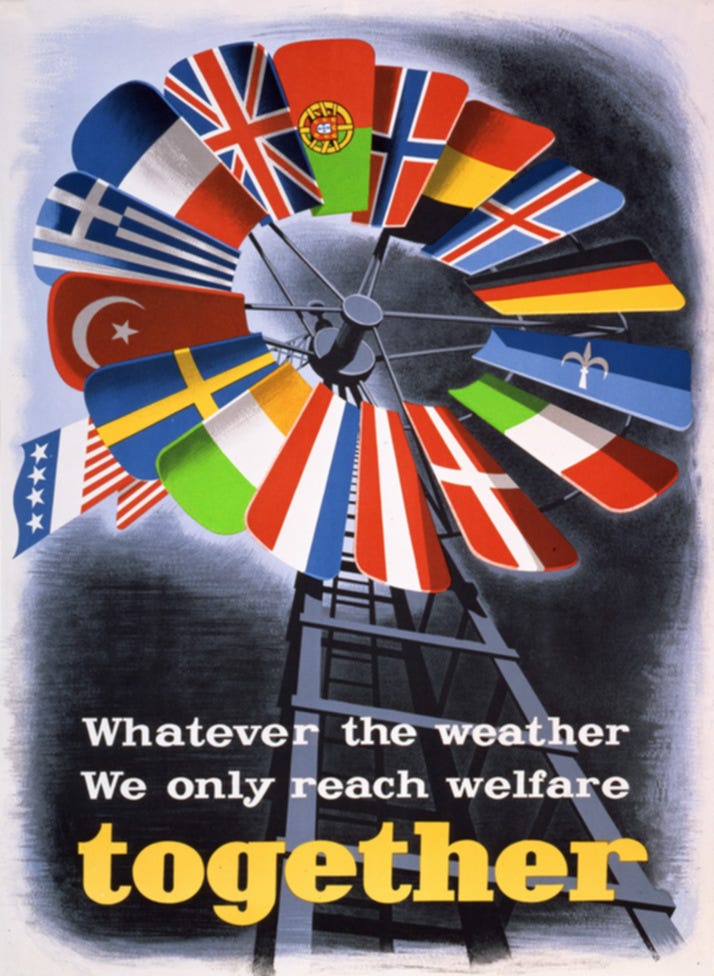
Marshall, along with other figures in the United States and Allied governments, believed that economic stability would be able to provide political stability for a war-weary European populace. Formally called the “European Recovery Program,” the U.S.-sponsored project was later fleshed out on paper and passed by congress in early 1948, with the aim to rebuild the economies of 17 Western and Southern European nations to foster stable conditions that would support the survival of democratic institutions. The United States was increasingly concerned that the poverty, unemployment, and disruption of the post-World War II era was growing the appeal of communist parties to voters in Europe.
In a continent devastated by the most destructive war in human history and on the brink of famine, America saw opportunity. Concocted by some of the brightest minds in the Truman administration, the United States, through the Marshall Plan, eventually contributed the equivalent of some $173.8 billion in 2024 dollars in capital and materials to economic recovery programs in Western European countries, including France, the United Kingdom, the Netherlands, Italy, and West Germany between 1948 and 1951. France was the one of the largest recipients of Marshall Plan aid, second only to the United Kingdom.
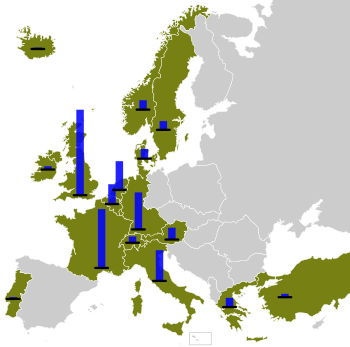
For years, countries like France clung to US imports like a life preserver, its head barely managing to stay above water. The flow of these billions also ensured that the United States had a great degree of latitude in dictating the policies of recipient nations’ governments so that they were cohesive with American standards and advanced American interests - chiefly, anti-communism - lest the United States turn off the Marshall Plan tap.
Highlighting the influence of the Marshall Plan during the early post-war years, the National Archives (rather mildly) states that:
"For the United States, the Marshall Plan provided markets for American goods, created reliable trading partners, and supported the development of stable democratic governments in Western Europe."2
A picturesque sea-side city just west of the French Riveria, Marseille held the key to a successful implementation of the Marshall Plan. It’s France’s second-largest city and single largest port - described as “a vital beach-head for Marshall Plan exports to Europe.”3 One of the oldest cities in France, it was founded by Greek mariners in approximately 600 BC, and has enjoyed a healthy reputation as a top tourist destination for centuries since. In the 18th century, the city was an enthusiastic participant in the French Revolution - the French national anthem is “La Marseillaise” for good reason. It also has the dubious title as the capital of France’s criminal underworld, often depicted in French pulp magazines and novels as the home of the French gunslinger and outlaw. And, much like the rest of pock-marked France in the aftermath of the second world war, rebellious Marseille was on the brink of civil war.
By 1947, the fight against the Nazis was over but a new fight had started; France was in a state of political turmoil. The country had undergone 30 governmental changes in a year, and the single largest party in France had grown to become none other than the Communist party, who had made significant inroads with voters owing to their virulent anti-Nazi rhetoric and record during the war.
During the summer of 1947, the US State Department expressed its nervousness over the political developments in France. US officials were stuck between a rock and a hard place: they feared that should the Communists come to dominate the French government, the party would exercise a virtual “veto power” over French foreign policy that would prevent it from aligning with US interests, and further, direct its foreign policy in such a way that would be advantageous to the Soviet Union. At the same time, they knew that any overt attempts by the US to sway French politics would be fiercely rejected by the French population and likely inspire an anti-American backlash. In response, Secretary of State Marshall proposed in 1947 that:
“It is obviously not possible or desirable that the US government should create 'fifth columns' or underground organizations [in France]. Support of a financial or other nature could be given to existing organizations, native to the country at issue, which are at present combatting communist penetration.”4
As head of the State Department, Marshall advocated for Congress to give him a “secret fund . . . to be used in his absolute discretion for the security' of the United States.”5
The State Department also added that “a communist presence in the government would 'greatly diminish the prospects of vital American economic and financial aid,’” and suggested “‘intensive cultivation of French newspapers by direct or indirect means,’ without seeming to interfere directly, to prevent the re-entry of the communists into the [French] cabinet.”6
"I told Ramadier," US Ambassador to France Jefferson Caffrey wrote in his diary in 1947, "no Communists in gov. or else."7 (Paul Ramadier was the French premier, or prime minister, from January to November 1947.)
At the behest of a skittish State Department, the first American covert operations in France began in 1947 with the aim of undermining communist support in the country, while propping up more US-friendly interests.
At the time, the chief opposition to the communists in France were the Gaullists, a French political party led by former General Charles de Gaulle and whose politics can generally be described as conservative or right-wing. Though the Americans viewed the Gaullists with distaste, they seemed far more attractive than the communist and socialist parties in France.8
By the time of the French municipal elections in October 1947, those same Gaullists won “a stunning victory” over their communist and socialist rivals with 40% of the vote - a welcome development for the State Department.9
But with the election of Gaullist Michel Carlini as mayor in 1947, the city of Marseille served as a microcosm for the state of French national affairs, and not entirely by accident.
The welcoming of a conservative mayor in Marseille was the straw that broke the camel’s back; the months of tensions between conservative and communist elements in Marseille, which had served to gradually build the community into a social powderkeg, finally exploded into chaos.
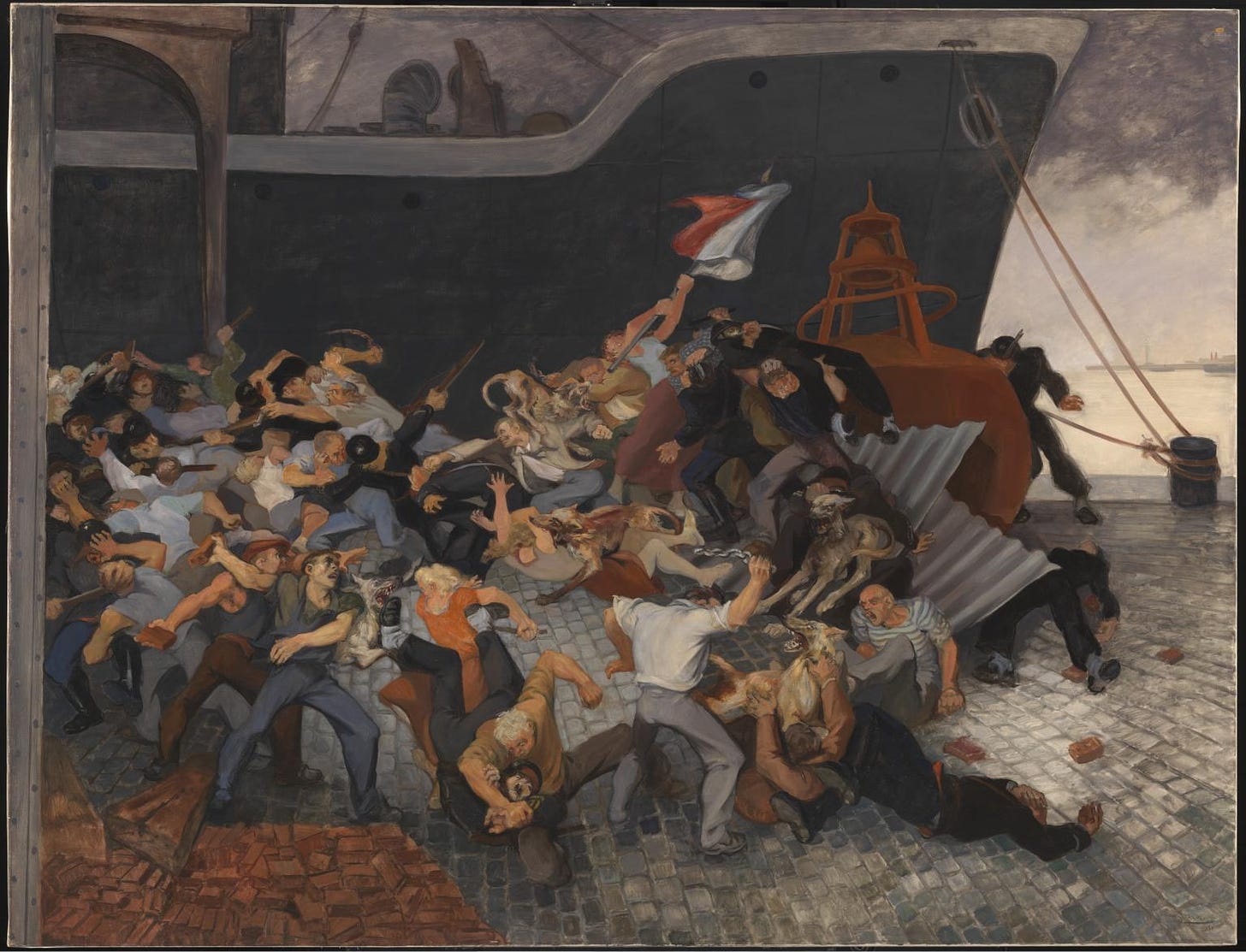
Angry communists protested loudly in the streets, and violent clashes with police and counter-protesters were frequent. It wasn’t hard to see why people were angry; by 1947, French workers only made 65% of what they had made before the war.10 As a consequence, disgruntled workers needed little convincing to heed the call of communist activists to participate in labor strikes that paralyzed industry across the country without prejudice that year. With their aggressive focus on worker’s rights and anti-Nazism, France’s most influential unions had grown to be communist ones, such as the General Confederation of Labour, or CGT - during the second World War, it was estimated that nearly half of French resistance members with a military background were communists, as well as one-third of those with civilian backgrounds.11
Eventually, these strikes came for France’s docks - the same docks that imported pre-Marshall plan American aid, such as food, clothes, and tools, and were supposed to be preparing for even greater shipments under the future program. Furthermore, the Soviet Union declared that the “Marshallization” of Western European countries, such as France and Italy, was to be resisted at all costs, and encouraged the French and Italian communist parties to lead the effort to sabotage it in their respective countries.12
The strikes in the winter of 1947 had French authorities and their American allies sweating. If the dockworker’s strike went on for too long, the Marshall Plan would be kneecapped before it even fully got off the ground. For the Americans, this meant the loss of influence over a key ally and the possible rise of a pro-Soviet, anti-American power in Western Europe.
For the French, this meant people would likely starve, and France’s reconstruction would drag on even longer.
Undersecretary of state Robert Lovett wrote at the time:
“It has been clear since the Liberation that the isolation and ostracism of the French communists was essential if France was to remain in the western orbit. It was equally clear that politically speaking the break must come to the left of, or at the very least, in the middle of the Socialist Party. Translated into labor terms, the healthy elements of organized labor must be kept in the non-communist camp.”13
And the CIA did exactly that. Determined to wrest control of the docks from the communists, the CIA initiated covert operations designed to subvert communist activity to supplement those of the State Department in Marseille and other cities. Coordinating with local socialist unions, such as the Force Ouvriere (FO), their efforts were designed to splinter and weaken the French leftist labor movement, which it did to great success. According to Historian Edward Rice-Maximin:
“For several weeks American union leaders and CIA agents had been trying to get Leon Jouhaux's Force Ouvriere to break off from the CGT. [US Ambassador] Caffery called the split 'the most important event that has occurred in France since the Liberation', and Blum told him that the intervention of American labour leaders had been 'very helpful in strengthening the determination of French non-communist labour leaders.”14
With American help, the dissention between labor unions like the socialist Force Ouvriere and the more hardcore, communist CGT caused the 1947 strike to quickly fall apart. The State Department could breathe a sigh of relief — for now. But, Rice-Maximin adds,
“Although they no longer feared an insurrection or prolonged political strikes, the Americans were keenly worried about the communists' ability to disrupt economic activities. Caffery feared that they would 'raise the cost of France's recovery under American aid to the maximum extent', keep France in a state of 'permanent pre-revolutionary ferment', and force the non- communist unions to go along with their wage demands… if the [French] government could not stabilize prices and stop the decline in real wages would the communists again appeal to the average worker. Otherwise the communist movement would continue 'to hang like a Damocles sword over the head of any government in France'.”15
By 1948, despite the new aid received through the Marshall plan, the French were still not content. Rice-Maximin continues,
“Although continually disillusioned with the socialists and the 'third force', the United States still favoured a 'middle-of-the-road government' in France. She flatly rejected the Gaullist alternative and was in no way willing to let the communists re-enter the cabinet. When a close associate of Premier Queuille discreetly inquired about the latter possibility (in order to avert a threatened coal strike in the fall of 1948), Ambassador Caffery sternly replied that 'this would unquestionably mean the cessation of US aid to France'. He then reported to Washington that 'we could be sure that the matter was absolutely settled'.”16
Caffrey’s threats provided a fearsome incentive for the French to crack down on dissent.
Even given the general conditions of France at the time, the Americans still did not view the strikes as legitimate but rather as subversive political tool wielded by the communists:
“The official American position was that the strikes were political… Secretary of State Marshall replied that the strikes were 'not being carried out primarily in the aim of satisfying the legitimate demands of the miners but rather to paralyze French recovery and to discourage the American people and Congress from continuing [Marshall] aid'. [Ambassador] Caffery reported that Leon Blum had been stupified over Lewis's failure to understand 'the essential nature of the strikes', i.e. that they were a Comintern manoeuvre, foreign-inspired and communist-led.”17
And despite their initial successes of 1947, Caffrey wrote in 1948 with growing pessimism that,
“Industrial and white-collar workers, whatever their political affiliations, are united in the conviction that they are not receiving their fair share of the French economic recovery made possible by [the Marshall Plan]...There is real evidence that the trend which resulted in the split between communist and non-communist labour unions (the capital event of post-war France) has come to a stop and may be reversed and replaced by a trend toward unity in which the superior organization of the communists would prevail.”18
French workers were quickly losing confidence in the leadership of their non-communist, US-backed, socialist labor unions.
Two years later, an apprehensive US embassy in Paris reported that it had undertaken “informal conversations” with Premier Queuille’s office on “what measures [could] and should be taken by the French government to counter-act [the Communist party’s] effects and put the Communist party on the defensive.”19 The embassy concluded that without swift and effective action from the French government, the appeal of the Communists’ campaign in France would have “far-reaching and highly unsettling effects on French opinion, not only on the internal political level (but also on) the Atlantic Pact, the proposed Military Aid Program, United States foreign policy in general, [and] the role in foreign affairs of the French government.”
By late 1949, the new US Ambassador in France David K. Bruce believed that conditions in France were evolving such that “it might once again be possible for the communists to engage in political strikes” and Communist propaganda regarding the Marshall Plan and recent French military action in colonial Indochina was “beginning to make sense to the masses.”20
By 1950, with the looming prospect of new strikes in France and particularly a strike in Marseille on the docks through which Marshall Plan aid flowed, the Americans were concerned that their worst fears were about to be realized. In response, they pulled out all the stops and unleashed the full might of the American CIA to crush the strikes, including calling on some old friends who had helped them during the 1947 strikes that had similarly paralyzed France.
State of the Union (Corse)
One part of this subversion included collaborating with groups such as the French mafia, specifically, the Union Corse, or Corsican milieu, made up of individuals native to the French island of Corsica. The Union Corse had a long criminal history in France, and even more pertinently, experience in strike-breaking. It had cracked more than a few Communist skulls for Marseilles’ fascist mayor Simon Sabiani in the 1930s, and many of its members had informed on Communist and French Resistance activities for the occupying Nazis during World War II in exchange for their criminal activities remaining unmolested.21 The syndicate was then the natural choice to help break up the strikes in 1947 and 1950, though this latest alliance would have long-lasting consequences, including helping establish Marseille as “the heroin capital of the Western World.”22
Heroin manufacturing facilities had been uncovered in Marseille as early as 1937, primarily operating under the auspices of legendary French gangsters Paul Carbone and François "Lydro" Spirito.
However, the outbreak of the war dampened criminal activity, and the French underworld’s organizing ability was severely hindered by Carbone’s death in 1942 at the hands of French Resistance members, as well as Spirito’s flight from France in 1944, after the country’s liberation, in order to avoid French authorities hellbent on exacting revenge on collaborators.
In the vacuum, two men rose to the occasion.
In the immediate post-war era, by far the most influential gangsters in Marseille came to be the Guerini brothers Antoine and Barthelemy, hailing from, you guessed it, the French island of Corsica. Though much of the Union Corse had happily worked with the Nazis and French Fascists during the war, this was not uniform among all Corsican racketeers; the Guerinis had, in fact, been protégés of Carbone while he was alive but nonetheless supported the French Resistance during the war.23 Antoine was recruited as a British-American intelligence agent during the war, and hid English intelligence officers in the cellars of his nightclubs when they parachuted into Marseille to make contact with a French Resistance group there. Barthelemy supplied a local socialist militia with intelligence, arms, and manpower during the liberation of Marseille in 1944, for which he was later awarded the Legion of Honor by the French government. This reputation lent them a certain credibility within the post-war underworld and local populations, and probably made them very attractive to American intelligence officials looking for local support for new operations.24
But with the advent of peacetime in Marseille and the insurgence of more communist and socialist elements in France who were deeply opposed to the capitalist profiteering that organized crime represented, the relative freedom that organized crime groups had operated under during the war began to quickly disappear. To make matters worse, up until that point, French police had more or less adopted a “live and let live” attitude towards drug traffickers.
When Liberation came, much of the municipal police force, who had cooperated with the Germans during the war, simply disappeared. The new, hardcore French national police reserve that had been deployed across the country to replace them and combat crime, known as the CRS (Compagnies Republicaines de Securite), were not so accommodating:
“A high percentage of [CRS] officers [were] recruited from the Communist Resistance movement, and they performed their duties too effectively for the comfort of the milieu.”25
Many of these operations inevitably ensnared Union Corse members and shut down profitable activities connected to the Guerinis. Both parties finding themselves in a bind, the Americans and the Union Corse found themselves in an unholy alliance against their shared enemy: the communists.
Election Day
In 1947, Michel Carlini had won the municipal election for mayor of Marseille, unseating the previous communist incumbent. One of his first acts in office was a seemingly innocent decision to increase tram fares across the city that November.
It was a sound, economic choice designed to combat growing budget deficits; nevertheless, the move provoked widespread outrage and bitterness amongst the city’s population - with high unemployment, low wages, and a lack of most basic commodities, a simple fare hike served to stretch Marseille’s pockets even thinner. The CGT responded with a call for a “militant boycott” of the city’s tramways:
“Any motorman daring to take a tram into the streets was met with barricades and a shower of rocks from the angry populace.”26
More ugly incidents that month only served to further incense the strikers, now 80,000 strong; the day of November 12th alone saw demonstrations from thousands of angry workers outside a Marseille courthouse demanding the release of four sheet metal workers who had attacked a tram, the beating of Communist city councilors at a city council meeting (by Guerini associates), and the murder of a working-class demonstrator, shot and killed outside one of Antoine and Barthelemy’s clubs.27
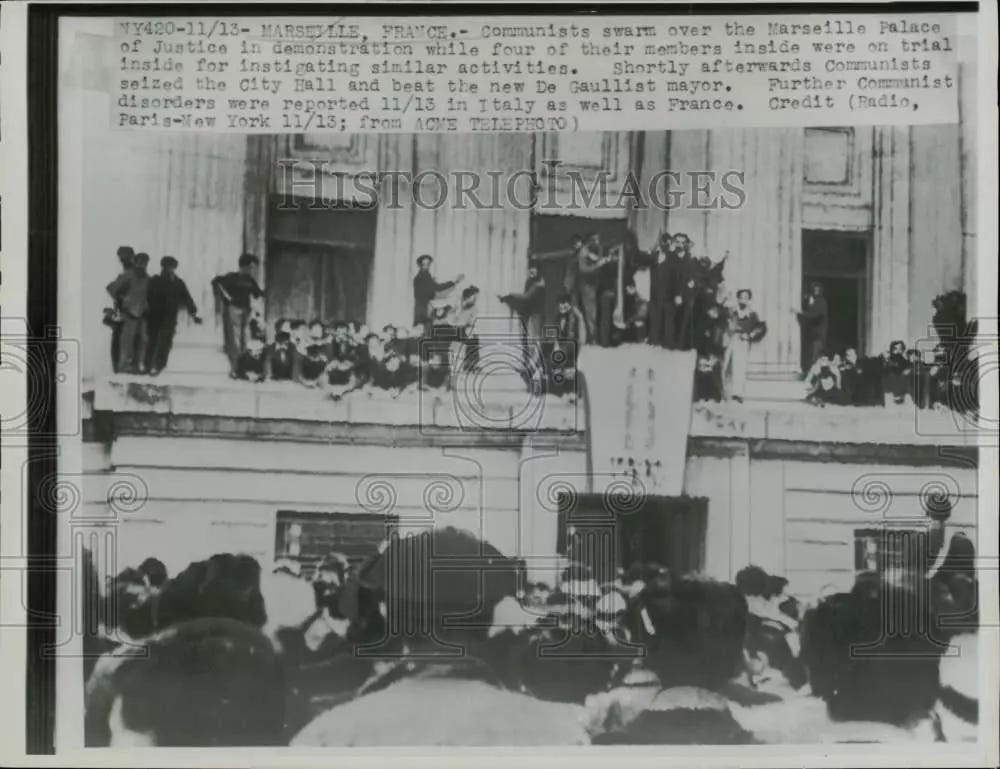
The morning after the murder, the Communist newspaper La Marseillaise pointed the finger at the Guerini brothers as being responsible.28 Later, in a court hearing on November 16th, two police officers testified that they had witnessed the Guerinis firing into the crowd. However, four days later, the police officers recanted their testimony and all charges against the Guerinis were dropped.29
In the court of public opinion, however, the Guerinis were still seen as far from innocent, as one excerpt shows:
“Several days later, Communist deputy Jean Cristofol rebutted [Socialist leader] Defferre's accusations, charging that the Guerinis' gangsters were in the employ of both Gaullist and Socialist parties in Marseille. When Defferre rose to deny even knowing Guerini, another Communist deputy reminded him that a Guerini cousin was the editor of Defferre's newspaper, Le Provencal. Then Cristofol took over to reveal some disturbing signs of the Marseille milieu's revival: underworld collaborators were being paroled from prison and government officials were allowing milieu nightclubs to reopen, among them the Guerinis' Parakeet Club. Only six months earlier, Cristofol himself, then Marseille's mayor, had ordered the clubs closed.”30
This first taste of violence in free France seemingly only whetted the appetite of the Guerinis for communist blood in the months and years to come.
The city of Marseille was not alone in its unrest and violence, however; during 1947 wildcat strikes had broken out all across the country, in a diverse swath of industries and occupations, owing to the general economic conditions in France. On November 14th, 1947, the CGT formally called for a nationwide general strike. By the end of November, approximately 3 million French workers were on the picket line.
The United States did not interpret these strikes as genuine labor action but rather as a political ploy by the Communists, with the help of the Soviet Union. In one of its first operations since it was founded earlier that year in September, the CIA swooped in to breakup the momentum of the strikes and the Communist party.
In the immediate postwar years, CIA covert-action programs like the one targeted at Marseille had grown in Europe. A Communist expansion into Western Europe seemed a real threat. The Red Army had already occupied Eastern Europe, and the war-ravaged countries of the West, then trying to rebuild their shattered economics, were particularly vulnerable politically. Consequently, the CIA subsidized political parties, labor unions, magazines, and other groups , especially in West Germany, France, and Italy.
Historian Alfred W. McCoy, author of the book The Politics of Heroin: CIA complicity in the Global Drug Trade, states that:
“In Marseille the CIA joined forces with the Corsican underworld to break the hold of the Communist Party over city government and to end two dock strikes-one in 1947 and the other in 1950- that threatened efficient operation of the Marshall Plan and the First Indochina War…”31
In response to the 1947 communist-organized strikes, the CIA’s newly-inaugurated psychological warfare team arrived in France to deal directly with the Corsican syndicates, primarily the Guérini brothers. They eventually formed “elite criminal terror squads” that help break up picket lines and harass union leaders on the docks, supplying the gang with funds, arms, and perhaps most importantly, protection from police scrutiny.32 The CIA further inundated French radio and print media with propaganda designed to break support for the strike; at one point, the US government even threatened to return much-needed aid shipments of flour unless the cargo was unloaded immediately by the striking dockworkers.33
Using conduits such as the AFL-CIO (an American labor union), the CIA was able to funnel approximately 2 million dollars a year clandestinely to socialist Force Ouvriere. AFL-CIO Union president George Meany would later brag that his union had “financed the split in the Communist-controlled union in France - we paid for it, we sent them American trade union money, we set up their offices, we sent them supplies.”34 Socialist unions such as the Force Ouvriere, who were rapidly losing ground and membership to the Communists, were only too happy to take CIA money.
Letters to the Editor
Further CIA payments to the French Socialist party in the amount of one million dollars a year helped it build up its political strength and electoral base within the labor movement, which it promptly used to condemn and discredit the strikes:
“While Marseille Socialist leader Gaston Defferre called for an anti-communist crusade from the floor of the National Assembly and in the columns of Le Provenqal, Socialist Minister of the Interior Jules Moch directed massive police actions against striking workers. With the advice and cooperation of the U.S. military attache in Paris, Moch requested the call-up of 80,000 reserves and mobilized 200,000 troops to battle the strikers. Faced with this overwhelming force, the CGT called off the strike on December 9, after less than a month on the picket lines.”35
Moch also oversaw the mass-purging of CRS units, who had been accused by Socialist contingents of siding with demonstrators. After a list of suspected communists was drawn up, Moch ordered the officers fired, despite many of their spotless records.
Following this shakeup within the police force, the CRS began “attacking picket lines with unrestrained violence” and the Corsican syndicates found the new CRS far friendlier than its previous, “redder” version.36
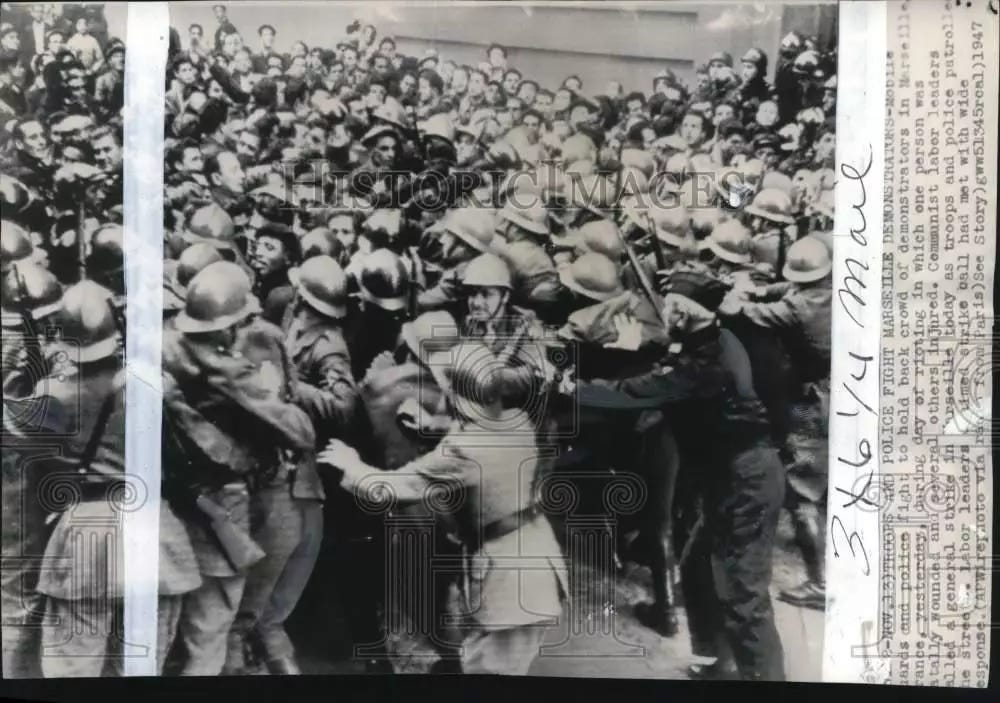
By December 9, 1947, the strikers had had enough; the dockworkers of the starving city abandoned the strike. The Americans’ plan had worked, with one major side effect: the protection and support of the criminal syndicates used to break the strikes had now left those same elements in charge of the docks.
Much of the same economic conditions that led to the 1947 strike also contributed to the subsequent 1950 strike. Additionally, Marseille’s role as a major port city also meant that its ports were now being used to transport large quantities of military equipment and supplies to French troops fighting to maintain control of France’s colonial possessions in Indochina, a war that was deeply unpopular among many French. With the initiation of a new round of strikes in February 1950 designed to bring an end to the war effort and once again led by the CGT, it was reported that around 70% of Marseille workers supported the strike.37 The CIA once again leapt into action. In a February 1950 working paper, the agency noted with increasing concern that,
“The timing of the recent protest incidents at Toulon, Nice, and Marseille reveal that the French Communist Party (PCF) has organized special ‘commando’ bands of Party militants and thugs, and has widely dispersed these groups throughout France so that they can go into suddenly into the least-expected places. This complicates the problem of countering possible sabotage attempts, as police elements cannot be deployed in advance to prevent all such disturbances. The success of possible countermeasures will depend particularly on the decisiveness and speed with which action is taken…”38
Through coordination with its union contacts, the CIA imported scores of “scab” labor from Italy into Marseille as well as crews of Corsican criminals to help keep the docks running, in defiance of the strikers. Gangsters employed by the Guerinis were given the responsibility of beating Communist picketers to a pulp so that the scabs could safely work on the docks.39 Continued pressure from the CIA and local elements slowly but surely ensured that the strikes lost steam, and any attempts at a coordinated boycott were largely over by April.
The CIA were certainly, at the least, aware of who they were dealing with: in one declassified CIA cable, the agency reported that in 1950,
“one Guerrini [sic] telephoned and threatened with death Jean Cristofol, former Communist mayor of Marseilles; Marcel Guizard, director of the Communist paper, La Marseillaise; and Andre Carrel, editor of La Marseillaise.”40
Later, in a 1951 CIA declassified document titled “Psychological Operations Plan Incident to Reduction of Communist Power in France” written in the aftermath of the 1950 strikes, the agency wrote,
“Future aid going directly to lower union levels could be used to spark recruitment drives, pay the expenses of trained organizers, and finance non-Communist labor propaganda. Only about three million out of the total of eleven million French workers are organized. Aid used specifically to win over the unorganized should bear more positive results than that given in the past. Any financial aid given to the FO or the CFTC [another French Union] should be extended discreetly, however, in order to avoid association of these unions with the US in the public mind. The allegation that non-Communist unions are subsidized by the US would seriously limit their effectiveness.”41
The CIA paper went on to explain: “There are 4,200 dockers in Marseille. One thousand of these belong to the CGT, but only 300 are considered to be ‘hard-core’ Communists. The FO and CFTC each have about 600 members among the dockers, and the remainder belong to no union.”
Over a decade later in 1967, the Washington Post reported that a Corsican politician by the name of Pierre Ferri-Pisani had been the recipient of a $250,000 retainer by the CIA, in cash, for helping break up the first Port of Marseille longshoreman strike in 1947 “by whatever means necessary.”42
Ferri-Pisani could be described as many things, but a gentleman was not one of them. He was quoted by TIME magazine in 1952 as saying to a communist union boss during the February 1950 strikes,
“If there is any trouble on the docks, we will not bother with the men you send to cause it. No, within 48 hours we will ask you to pay personally.”
The magazine remarked that “the first Communist who tried to fire Ferri-Pisani's men was chucked into the harbor."43 The same article also went on to quote then-Under Secretary of State Nicholas Katzenbach, who confirmed that the CIA’s funding of these groups was not a unilateral act but had in fact been done with the tacit approval of the National Security Council, the Secretaries of State and Defense, and the congressional oversight committees designed to monitor the agency.
The CIA’s role in the strikes was, perhaps redundantly, made further transparent when later in 1967 Thomas Braden, the former director of the CIA's international organizations division and assistant to director Allen Dulles, revealed in rather blunt terms that,
“It was my idea to give $15,000 to [labor leader] Irving Brown. He needed it to pay off his strong-arm squads in the Mediterranean ports, so that American supplies could be unloaded against the opposition of Communist dock workers."44
The CIA’s involvement in organized labor in Europe, and in the collapse of the Marseille dock strikes specifically, was not a particularly well-kept secret.
But who was Irving Brown?
At the time, Irving Brown was the American Federation of Labor’s (AFL) head representative in Europe, deeply involved working to build trade unions in post-war Europe free of communists, or, in other words, friendly to American interests. In 1952, Brown was celebrated as “The Most Dangerous Man” in a profile by Time for his work across the continent.
Outside of the Time offices, he was more commonly known by the less affectionate nicknames “chief union splitter” and “racketeer.” Of specific interest among his accomplishments were his work “[supplying] the moral and financial backing to the anti-Communist movements which broke the French and Italian Red-led general strikes of 1947,” as well as his formation of the Mediterranean Port Committee, which is credited with “wrest[ing] control of French, Italian and Greek ports from the Communists.” TIME further described how the creation of the anti-Communist trade-union federation Force Ouvrière was only possible with the help of Brown. André Lafond, a key secretary of FO at the time, said: "In the history of European labor, Brown will be more important than all the diplomats put together."
“It has been hard to avoid the conclusion,” the American consul wrote at the time of Brown’s activities in Marseille, “that the Mediterranean Committee has been consistently more interested in the political struggle than in organizing a union.”45
“With funds from [the AFL-CIO],” added Thomas Braden, “they organized the Force Ouvrière, a non-Communist union. When they ran out of money, they appealed to the CIA. Thus began the secret subsidy of free trade unions, which soon spread to Italy.”46
Though Brown always vigorously denied any connection between himself and the CIA, former CIA agent John Stockwell later characterized him as “Mr. CIA in the labor movement,” and another former CIA official, Paul Sakwa, confirmed that he “served as Brown’s case officer… in the CIA for several years.”47
Brown and Ferri-Pisani were not only apparently both handsomely paid by the CIA, but they were good friends too. “Brown was decisive. He was the only one to back us before we even had a union,” said Ferri-Pisani.
However, fellow French union leader Augustin Marsily, who by his own admission “threw 4,400 men into the port of Marseille” to help break the 1950 strike, complained to Brown that Ferri-Pisani was in bed with gangsters, and as a reward for their cooperation in breaking up the strikes “had imposed as the head of the ‘free’ dockers’ union ‘common criminals.’”48 Marsily grew so frustrated with the FO that he actually split to create his own union free of corruption.
According to historian Irvin M. Wall, “The CGT [the French communist union] was accused of harassment of workers who tried to ignore its strike calls; Brown and Ferri-Pisani, through the anti-Communist Mediterranean Port Committee, organized their own shock troops to take control of the ports, lavishly distributing funds for that purpose.”49 Brown offered anyone in the FO willing to get rough $5,000 every three weeks, and advanced the organization a $25,000 loan from the AFL with no expectation of “immediate payment.” The French Ministry of Labor even got in on the action - frozen labor funds from the Vichy regime, the French Nazi puppet government during the war, were quickly unfrozen and granted to the FO, reaching a total of 40 million francs, or approximately, an astounding $150,000,000 today (though it is unclear how much precisely was actually spent for this purpose).50
In total, it was estimated that CIA itself gave the French trade unions over three million dollars in aid using the AFL as a conduit - one million before, and approximately two million after 1950, with the majority of this money funding the militancy at the docks.
Following the collapse of the 1950 strike, the Socialist party emerged victorious in local elections in a political dynasty that would last nearly a quarter of a century. During this time, the Guerinis kept the Socialists close, and were documented as “acting as bodyguards and campaign workers for local Socialist candidates” until the late ‘60s.51
According to French police, by 1951, Marseille's first post-war heroin laboratories were established, just months after the milieu gained control of the waterfront.
The Needle and the Damage Done
By the ‘70s, The Federal Bureau of Narcotics (FBN) reported that Barthelemy Guerini "‘finance[d] various criminal activities in the Marseille area, particularly the illicit narcotics traffic’ and described him as ‘an arbiter and overlord in the Marseille underworld’ with associates among the ‘top echelon of French narcotic traffickers.’”52
A testament to the strength of his political connections, Guerini was never convicted for any of his enterprises, despite his high-profile presence in the Marseille milieu.
In a 2024 interview, reporter Ioan Grillo spoke to Emile Diaz, nickname “Milou,” one of the few surviving Cold War-era Corsican gangsters, who confirmed firsthand that he ran drugs for the Guerinis:
“The gangsters laundered their vast profits in Marseilles with the help of a friendly mayor. And even if they were caught, there was only a five-year sentence for heroin trafficking … They were very much in the game. ‘They bought a lot of night club[s] with prostitutes, and they told people, “Yeah we make money with this.” But I delivered drugs for the Guerinis in their establishments.’ ”53
But what did French intelligence, the SDECE, have to do with any of this?
If the CIA had helped plant the seeds of the heroin trade in Marseille, the French intelligence services took care of its sprouts until it bloomed. In his groundbreaking work The Politics of Heroin in Southeast Asia (1972), McCoy describes extensively the role of the French intelligence services in facilitating the opium trade during the French Indochina war. He describes them as equally complicit in Marseilles’ heroin trade, writing that,
“The U.S. Bureau of Narcotics [one of the preceding agencies to the Drug Enforcement Administration] believes that the Gaullists have replaced corrupt Marseille politicians as [organized crime’s] most important protectors, and some U.S. narcotics agents have become quite concerned over the complicity of high level French intelligence officials in the narcotics traffic.”54
While the CIA had helped organized crime gain a foothold on the docks, it was French intelligence that ensured they flourished in the decades to come.
In one instance, US narcotics officials alleged that French intelligence had warned Corsican drug traffickers of a US criminal investigation into their heroin smuggling.55 John Cusack, head of the European division of the U.S. Bureau of Narcotics and Dangerous Drugs, angered French police in 1971 when he made the glaringly obvious observation that drug traffickers operated in Marseille with “tranquility” and “not elsewhere.”56 Despite the increasing attention American officials were placing on narcotics interdiction, conversely, little had changed in regard to French drug trafficking policy. As early as 1953, FBN agent Charles Siragusa had stirred political controversy when he expressed his disgust towards what he perceived as drug-related corruption in France. In an opinion article for the New York Herald-Tribune, written following the sentencing of two Corsicans in Marseille caught with a kilo of heroin to three and six month suspended sentences each, he said:
“[Marseille is] unquestionably the most important narcotics smuggler’s haven in France and probably all of Europe… there are at least 5 large heroin laboratories… [The Corsicans] exercise a virtual monopoly of the illicit narcotics traffic in France… [smuggling] opium, morphine base and heroin from Beiruit and Indo-China into Marseille…
Corsican criminals residing in the United States… have long been prominent narcotics suppliers. Since the war, they accelerated their activities… The Marseille courts nullify the excellent enforcement efforts of the French police… as long as these ridiculously shocking sentences are meted out, heroin smuggling to the United States will get progressively worse.”57
A congressional report commissioned in 1970 by Representatives Morgan F. Murphy of Illinois and Robert H. Steele of Connecticut titled “The World Heroin Problem” agreed with much of these allegations, charging that there had never been any serious police efforts by the French to disturb heroin traffickers in Marseille, and naming four families primarily responsible for the trade - one of which was the Guerinis. Why was that?
Perhaps some insight can be gained from talking to the criminals involved.
In 1962, across the Atlantic from Marseille in New York City, a nervous, pot-bellied Corsican by the name of Etienne Tarditi was spilling his guts. He had been arrested alongside Guatemalan ambassador Mauricio Raul in a plot that exploited diplomatic privileges to smuggle heroin into the United States from Marseille. Tarditi claimed to “have highly placed friends in the French government” and according to officials “mentioned belonging to the Gaullist anticommunist political groups and intimated that he was involved in intelligence work beneficial to American interests.”58 Whether these claims in particular were ever substantiated is not clear, but the reliability of Tarditi’s mountains of information on Corsican drug trafficking operations made this aspect of his confession all the more interesting.
Around the same time, tucked far away within the jungles of Indochina, Colonel Edward G. Landsdale of the CIA recalled being “appalled” upon witnessing firsthand the extent of the colonial French intelligence services’ direct involvement in opium smuggling out of Indochina. When Lansdale complained to his superiors in Washington about the flagrant involvement of French intelligence in the heroin trade, he was rebuffed. Paraphrasing their response in a 1971 interview, he said that their reply was:
“Don't you have anything else to do? We don't want you to open up this keg of worms since it will be a major embarrassment to a friendly government. So drop your investigation.”59
The parallel claims of French facilitation of the heroin trade across the Atlantic seemed to be vindicated when in 1971 US authorities indicted Colonel Paul Fournier, a major supervisory figure within the SDECE and former official in charge of French espionage activities in North America, as well as drug courier Roger de Louette, a retired SDECE agent, on drug trafficking charges.60 The Colonel and deLouette were accused of attempting to smuggle 45 kilos of heroin, worth approximately $90.5 million adjusted for inflation, into the United States through a port in Elizabeth, New Jersey.
In the wake of the scandal, French Colonel Roger Barberot confirmed the identities of Louette and Fournier as intelligence agents in an interview with Radio Luxembourg and stated,
“My conviction is—and some will tell you so officially — that the operation was mounted by a certain number of S.D.E.C.E. agents in Paris itself."61
The criminal proceedings caused several SDECE employees to speak out on abuses by the organization, including drug trafficking.62 According to the Algerian newspaper L'Aurore, Colonel Fournier in the past allegedly “did not hesitate to use information amiably communicated to him by certain services of eastern countries,” and, “talked of drug routes, of the collusion, of C.I.A. members in these rackets, etc.” The New York Times reported at the time that “at least three men arrested on drug charges in recent years had worked for the intelligence agency.” Louette was eventually sentenced to 15 years in prison for his role in the plot; as a matter of habit, France does not extradite its citizens to anyone, including the United States. So Fournier, who was still in France, never stood trial.63 Louette maintained that he had been acting “as an agent of French intelligence” but that “Colonel Fournier ‘was just a cog’ in the heroin plot and was being directed by supervisors in the counterintelligence agency,” a claim bolstered by Louette’s successful passing of several lie detector tests administered by American law enforcement.64 Fournier presumably died in France a free man.
When it came the “French Connection” between the US and France, “French intelligence was running the show,” said Federal Bureau of Narcotics (FBN) agent Tom Tripodi in an interview in 1999.65 Fellow FBN agent Martin Pera stated, “By the 1960s, it was obvious that Far East Asian dope was coming to the US, and everyone was pre-occupied with the fact that it couldn’t happen without [the] SDECE.”66
By the 1970s, the thuggish and undisciplined nature of the SDECE threatened to sink the operating efficiency of the agency. In 1971, the French president appointed Alexandre de Marenches director, tasked with straightening out the agency. Marenches made radical overhauls to clean up the SDECE, including firing over half of its employees and changing its direction from what had essentially become an assassination tool to a true, bonafide intelligence agency.
"Some agents were running drugs and guns; others were engaged in kidnapping, murder and the settling of the most bloody scores," lamented Marenches.
Among other things, the increasingly frequent arrests of individuals within the French political power structure in the late ‘60s and ‘70s relating to heroin smuggling only seemed to cement the suspicion that the drug trade had become fully entrenched within the country’s establishment.67 But by the mid-70s, things began to take a turn for the worse for the Corsicans.
The Guerinis successfully avoided prosecution for their litany of crimes owing to their relationship with Marseille’s socialists.68 But by 1970, the power of the Socialist party had declined substantially in favor of the Gaullists, who had grown connections with rival gangster Marcel Francisci. On January 15, 1971, a French court returned a guilty verdict, convicting Barthelemy and a group of Guerini associates for murder. Barthelemy’s brother, Antoine, had been gunned down four years earlier in 1967. Absent the Guerini’s iron fist, by the mid-70s, the heroin racket in Marseille became increasingly fractured.
“As one of France's top police officials put it, ‘These new guys are guys who don't follow the rules. With tougher U.S. suppression effort, the cost of smuggling got too much for some of them, so they took the easy way out and began to sell here.’ Within two years after Antoine Guerini's death and Barthelemy's incarceration, France itself was in the grip of an escalating heroin plague.”69
By 1972, the Marsielle police drug enforcement arm had been expanded to 77 officers, a dramatic increase from the 8 officers in 1969. The goodwill for the Guerinis and their early work in the dockstrikes waned as time passed: increased police and legislative scrutiny, criminal competition abroad, and a changing political landscape spelled the end of the French Connection that the Guerinis had largely helped create. According to the DEA, “by 1981, it was estimated that there was 40 percent less heroin available than in 1976,” believed to be a direct result of the collapse of the French Connection.70 But the damage was already done. By 1972, “fifteen out of every thousand French army draftees were being rejected because of drug addiction,” and French police declared drugs “France’s number-one police problem.”71 In the United States, which had been estimated to have a mere 57,000 addicts in 1965, the number of addicts had jumped to 560,000 by 1971 - a nearly ten-fold increase.72 By the mid-70s, the French Connection as authorities knew it had largely been replaced by opium sources in the Far East, such as in Vietnam and Hong Kong, as well as Afghanistan.
According to the National Center for Drug Abuse Statistics, approximately 902,000 people in the United States are addicted to heroin in any given year.73
Conclusion
The pragmatic support of the Corsican syndicates by the CIA, and by extension their drug dealing, was not a one-time phenomenon. This pattern of facilitating narco-trafficking continued well into the later half of the 20th century. The CIA would subsequently be accused of helping facilitate drug trafficking in numerous countries, including Korea, Honduras, Nicaragua, Venezuela, Afghanistan, and the general Southeast Asian region, all in the name of combatting communism, charges it always denied. Was it really any surprise that US law enforcement was helpless to stem the tide of drugs flowing into the country during the 20th century?
“You can trace very precisely during the 40 years of the cold war, the upsurge in narcotics supply in the United States with covert operations,” said Alfred McCoy.
In its heyday, the French Connection was believed by narcotics experts to be the source of the majority of heroin within the United States.74 Time magazine described Corsican organized crime as the leader in “worldwide trafficking in narcotics,” specifically heroin, and thriving under a post-war French government reluctant, or perhaps afraid, to interfere.75 The Bureau of Narcotics and Dangerous Drugs estimated that in 1972 alone, 80% of the heroin coming into the United States originated from labs in Marseille.76 However, the extent of the role of American and French intelligence in the creation and preservation of this dominance would not come to light until much later. In the aftermath, the Guerini brothers came to rule the French underworld.
“It goes all the way back to the predecessor organization OSS and its involvement with the Italian mafia, the Cosa Nostra in Sicily and Southern Italy,” said Victor Marchetti, former special assistant to CIA deputy director Rufus Taylor in 1988.
“Later on when they were fighting communists in France… they got in tight with the Corsican brotherhood. The Corsican brotherhood of course were big dope dealers. As things changed in the world the CIA got involved with the Kuomintang types in Burma who were drug runners because they were resisting the drift towards communism there. The same thing happened in Southeast Asia, later in Latin America. Some of the very people who are the best sources of information, who are capable of accomplishing things and the like happen to be the criminal element.”77
With these kinds of friends, who needs enemies?
In a 1993 article titled “The CIA Drug Connection Is As Old As the Agency,” the New York Times described how the CIA was able to hypothetically remain one step ahead of federal anti-narcotics efforts at all times, writing,
“To protect its ‘assets’ abroad, the CIA has ensured that the DEA's concerns outside the country were subordinated to its own. Until recently, no DEA country attaché overseas was allowed to initiate an investigation into a suspected drug trafficker or attempt to recruit an informant without clearance from the local CIA station chief. DEA country attachés are required to employ the standard State Department cipher, and all their transmissions are made available to the CIA station chief. The CIA also has access to all DEA investigative reports, and informants' and targets' identities when DEA activities outside the United States were involved.”78
The CIA’s early activities in France have received substantially less attention than its counterpart operations that it served as a model for, such as heroin smuggling in South East Asia during and after the Vietnam War, or with cocaine in South America via the Nicaraguan Contras during the Reagan administration. When it comes to charges of the agency’s “French Connection,” the agency simply seems to shrug its shoulders in resignation. Nobody seems to care that the premier intelligence agency of the U.S., the CIA, had helped whet Americans appetites for heroin, and cultivate the single-largest source of heroin import into the country in the 1960s and ‘70s - the French Connection.
Typically, any media response to well-founded allegations of government involvement in drug trafficking can usually be understood in two forms: disinformation, and accusations of crackpottery based on that disinformation. Reporter Gary Webb responded to criticism of his 1997 CIA-Cocaine exposé by pointing out how major media outlets had distorted his reporting on Nicaraguan drug traffickers the CIA had protected:
“We had The Washington Post claim that the stories were insinuating that the CIA had targeted Black America. It's been a very subtle disinformation campaign to try to tell people that these stories don't say what they say. Or that they say something else, other than what we said. So people can say, well, there's no evidence of this, you know . . . You say, well, this story doesn't prove that top CIA officials knew about it. Well, since the stories never said they did, of course they don't.”79
In his intense study of the CIA’s relationship with drug traffickers, McCoy also in states that:
“In most cases, the CIA's role involved various forms of complicity, tolerance or studied ignorance about the trade, not any direct culpability in the actual trafficking...The CIA did not handle heroin, but it did provide its drug lord allies with transport, arms, and political protection.”80
Essentially, the agency would never get its hands dirty directly.
If you had been accused of drug smuggling dozens of times, would anyone believe it was just a coincidence? Bad luck, maybe?
By no means is this is an exhaustive examination of the story of the Marseille docks; I’ll admit that this story has been covered far better and in much greater depth by the likes of Alfred McCoy (The Politics of Heroin in Southeast Asia) and others. But I thought I’d try my hand at it anyway.
Given these revelations, is it any surprise that the US can’t stop the massive amounts of drugs that flow into the country every year and the accompanying millions who become addicted? No, the CIA wasn’t injecting heroin into anyone’s veins directly, but their aid to drug-trafficking affiliates undoubtedly helped build the heroin problem we’re still wrestling with today. Any discussion on drugs in the US is a moot point; the “War on Drugs” was, and is, always designed to fail.
Encyclopaedia Britannica. 2020. "Human and Material Cost of World War II." Encyclopaedia Britannica. https://www.britannica.com/event/World-War-II/Human-and-material-cost.
National Archives. n.d. "Marshall Plan (1948)." National Archives. https://www.archives.gov/milestone-documents/marshall-plan.
McCoy, Alfred W. The Politics of Heroin in Southeast Asia. New York: Harper & Row, 1972. Page 59.
Rice-Maximin, Edward. “The United States and the French Left, 1945-1949: The View from the State Department.” Journal of Contemporary History 19, no. 4 (1984): 736. http://www.jstor.org/stable/260334.
Ibid.
Ibid.
Leffler, Melvyn P. A Preponderance of Power: National Security, the Truman Administration, and the Cold War. Stanford, CA: Stanford University Press, 1992. Pages 157–158. ISBN 978-0-8047-2218-6.
Rice-Maximin, 740.
Ibid., 737.
McCoy, 52.
Rieber, Alfred J. “COMMUNIST TACTICS IN FRANCE: 1945-1953.” Journal of International Affairs 8, no. 1 (1954): 73–85. http://www.jstor.org/stable/24355317.
Wettig, Gerhard. Stalin and the Cold War in Europe. Lanham: Rowman & Littlefield, 2008. Page 139. ISBN 978-0-7425-5542-6.
Rice-Maximin, 737.
Ibid, 729–47.
Ibid.
Ibid.
Ibid.
Ibid.
Ibid.
Ibid.
McCoy, 49-51.
Ibid., 47.
Ibid., 53.
Ibid.
Ibid., 54.
Ibid.
Ibid.
Ibid.
Ibid., 56.
Ibid., 60.
Ibid., 59-60.
Ibid.
Ibid., 25.
Ibid., 58.
Ibid., 59.
Ibid., 60.
Ibid., 62.
Central Intelligence Agency. Working Paper Division Weekly. Western Europe Division Office of Reports and Estimates, Central Intelligence Agency. February 21, 1950.
McCoy, 62-63.
Central Intelligence Agency. Communist Service d'Ordre. CIA report. https://www.cia.gov/readingroom/docs/CIA-RDP82-00457R006200690009-3.pdf.
Central Intelligence Agency. Psychological Strategy Board Report. CIA report. https://www.cia.gov/readingroom/docs/PSYCHOLOGICAL%20STRATEGY%20BO%5B15843872%5D.pdf.
Hardwood, Richard. “O, What a Tangled Web the CIA Wove.” Washington Post. February 2, 1967. https://www.cia.gov/readingroom/docs/CIA-RDP70B00338R000300030026-4.pdf
Time. “LABOR: The Most Dangerous Man.” Time, March 17, 1952. https://content.time.com/time/subscriber/article/0,33009,816103-2,00.html
Braden, Thomas. "I'm Glad the CIA Is 'Immoral.'" The Saturday Evening Post, May 20, 1967.
NARA, 851.062/5-2142, May 21, 1952; 12-153, December 1, 1953.
Braden, Thomas. "I'm Glad the CIA Is 'Immoral.'" The Saturday Evening Post. May 20, 1967.
Bonner, R. 28 October, 1985. New Republic. Guilt By Innuendo. https://www.cia.gov/readingroom/docs/CIA-RDP90-00806R000100010024-3.pdf
Wall, Irwin M. The United States and the Making of Postwar France, 1945–1954. Cambridge University Press, 1991.
Ibid.
Ibid.
McCoy, 63.
McCoy, 64.


McCoy, 67.
Jonnes, 180.
"U.S. Agent’s Drug Charges Anger the French Police," The New York Times, August 27, 1971, https://www.nytimes.com/1971/08/27/archives/us-agents-drug-charges-anger-the-french-police.html.
Jonnes, 172.
Valentine, Douglas. “The French Connection Revisited.” Covert Action Quarterly, 1999: 61-64.
McCoy, 140.
"French Secret Service Scandal Spreads in Wake of Drug Case." The New York Times, November 21, 1971. https://www.nytimes.com/1971/11/21/archives/french-secret-service-scandal-spreads-in-wake-of-drug-case.html.
"French Aide Backs U.S. in Drug Case." The New York Times, November 20, 1971. https://www.nytimes.com/1971/11/20/archives/french-aide-backs-us-in-drug-case-french-official-supports-u-s.html.
Le Monde, November 21-22, 23, and 27, 1971.
"Frenchman Sentenced for Smuggling." The New York Times, April 18, 1972. https://www.nytimes.com/1972/04/18/archives/frenchman-sentenced-for-smuggling.html.
"Drugs: The French Connection." 1971. Time, March 2, 1971. https://time.com/archive/6815134/drugs-the-french-connection/.
Valentine, 61-64.
Valentine, 61-64.
McCoy, p. 57.
McCoy, p. 66.
McCoy, p. 69.
U.S. Drug Enforcement Administration. 1980-1985: A Retrospective. Washington, DC: U.S. Drug Enforcement Administration, 2021. https://www.dea.gov/sites/default/files/2021-04/1980-1985_p_49-58.pdf.
Pantaleone, Michele. The Mafia and Politics. London: Chatto & Windus, 1969. Pages 167–179.
McCoy, p. 10.
National Center for Drug Abuse Statistics. Heroin Statistics. National Center for Drug Abuse Statistics. (2023). https://drugabusestatistics.org/heroin-statistics/
McCoy, p. 37.
Time. “The Milieu of the Corsican Godfathers.” Time, September 4, 1972. https://web.archive.org/web/20080607104719/http://www.time.com/time/magazine/article/0,9171,910391-1,00.html
"The French Connection in Real Life: Super Sleuths." The New York Times, February 6, 1972. https://www.nytimes.com/1972/02/06/archives/the-french-connection-in-real-life-super-sleuths.html.
"Guns, Drugs, and the CIA." 1988. PBS Frontline, March 4, 1988. https://www.pbs.org/wgbh/pages/frontline/shows/drugs/archive/gunsdrugscia.html.
"The CIA-Drug Connection Is as Old as the Agency." The New York Times, December 3, 1993. https://www.nytimes.com/1993/12/03/opinion/IHT-the-cia-drug-connectionis-as-old-as-the-agency.html.
U.S. Department of Justice. 1997. “THE CIA-CONTRA-CRACK COCAINE CONTROVERSY: A REVIEW OF THE JUSTICE DEPARTMENT'S
INVESTIGATIONS AND PROSECUTIONS.” Office of the Inspector General, Report of Investigation, 1997. https://oig.justice.gov/sites/default/files/archive/special/9712/ch01p1.htm.
McCoy, Alfred W., with Cathleen B. Read and Leonard P. Adams II. The Politics of Heroin: CIA Complicity in the Global Drug Trade. Revised edition. Chicago: Lawrence Hill Books, 2003. Page 385. ISBN 1-55652-483-8.