

The Lost Tribe of Alabama

The following article is reprinted from the March 1970 first edition of “Scanlan’s Monthly,” a defunct but groundbreaking muckraking magazine that operated from 1970-1971. The article’s author is Robert Severo, a journalist who worked at the New York Times from 1968-2006, though he often did freelance work (featured here). He was the recipient of a 1974 George Polk award for his writing, as well as an award from the Columbia School of Journalism. Severo died on June 12, 2023, at the age of 90.
No modifications have been made to his article except for formatting.

I was in a general store on Highway 43, perhaps 40 miles north of Mobile, and I was learning about the Cajuns of Alabama. Alabama Cajuns, not Louisiana Cajuns. Absolutely no relationship. No French patina, no grandma’s recipe for cuisson de chevreuil, no subscriptions to Réalités or schoolgirls singing, “Frère Jacques.”
He parked his rusty old Plymouth in the red Alabama mud and walked across the highway into the general store. He was rather ordinary looking and if the police had been looking for him they would have described him as a male caucasian, 5 feet 7 inches, 160 pounds. He asked for a loaf of white bread. The grocer gave him the bread, the man paid for it and left without saying a word. The screen door creaked shut and we were alone in the store.
The grocer - who also had brown hair and brown eyes and was, in fact, darker than the man who bought the bread - looked at me and said softly:
“That was one of ‘em.”
“That guy there?”
“Yessuh. He’s one of ‘em. A Cajun.”
“He looks white to me.”
“Yeah, he looks white. But he ain’t. He’s got them little black speckles around his forehead. That’s about the only nigger he’s got left in him, I guess, but it’s there. You just got to know where to find it.”
“You mean you can tell a Cajun every time?”
“Wellsuh, I don’t care to brag, but I do believe I can. Of course, I know ‘em all by name anyhow. But once in a while, I’ll git some from Calvert and on down the way, ones I ain’t never seed before. An’ I can tell with them, too. You can tell when you been in this kinda business for as long as I been. You just know.”
Then we could see that another car had pulled up and the grocer said, “Hush now, we got another one.”
This was an old man with light brown skin and a flat, broad nose and very bright blue eyes. He came into the store and he bought a pack of Camels. He left, like the other man, without saying a word.
“You see that?” the grocer asked. “He’s one of ‘em, too.”
The grocer chuckled. “Yessuh. His name is Reed and he is kin to that other feller. But that other feller, he won’t admit to it. They is both Reeds and they live back toward Reed Chapel aways. If you take that little side road over there and go in for a few miles, you’ll see a whole bunch of ‘em there. Yessuh, they is all Reeds. But if you git to know ‘em, you’ll see that the light-skinned ones don’t have an awful lot to do with the dark-skinned ones, even though they is kin. A light-skinned man, he don’t need no darkie kin. Fact is, none o’ these people admit to bein’ part nigger. If you listen to the way they tell it, they is all white.”
This was my first introduction to the Cajuns of Alabama. It happened three years ago. It was not until quite recently that I learned that the grocer on Route 43 (no longer in business) was a Cajun himself and that in his efforts to be “white,” he had become something of a Cajun-baiter, a man who had learned to deny his own ancestry because he found it more convenient to live with a lie than admit that 120 years ago one of his ancestors had been a Negro. The Cajuns are a people without a race and they have the great misfortune to live in a state where you must have a race so you’ll know where to go.
In 1850, a census talker looked at a Cajun family and said they were mulatto; in 1870 another census taker looked at the same family and said they were white. In 1960, the census takers were still confused. Of the 15,732 people they counted in Washington County, 10,066 were classified as white, 5,021 were classified as Negro and 285 were classified as “other.” But it would seem clear to anyone that there are more “others” than the census takers so classified, for until just this past fall, there were three kinds of school in Washington and upper Mobile counties - one for whites, one for blacks, and one for people in-between. Two of the so-called Cajun schools remain open even today and there are probably 700 youngsters from Cajun families now going to a school system under court order to integrate. But whether physical integration will undo the hurt that Alabama has inflicted on them remains to seen.
Since Cajuns do not officially exist, nobody knows how many of them there are. Some local guessers say 2,500; others say it might be four times that, especially if you count those who have left Cajun country and now live in Mobile or New Orleans or Pensacola, quietly and apprehensively, wondering when some Grand Inquisitor will find out that more than a century ago, an ancestor married an Indian or someone of mixed parentage.
But almost all the Cajuns live in a 175-square-mile area in upper Mobile or lower Washington counties, within 50 or 60 miles of downtown Mobile. They live in tarpaper shacks or, if they have a little more money, one of the small cabins common to remote backwoods areas of the South. The Cajuns are poor, even by the standards of rural Alabama. Nobody keeps records on them (you can’t keep records on something that doesn’t exist), but the Cajuns themselves estimate that 25 per cent of the families (which range between 7 to 10 members on the average) live on $1,000 a year or less.1
They are sick. Cajun men suffer from a chronic hyper-ventilation syndrome; too much air in the lungs because of the short, nervous breaths they take. The men also complain of “the bellyache” and high blood pressure, and doctors treat them for ulcers. When a doctor told me that, I was incredulous. “How does one manage to get ulcers in the piney woods?” I asked.
“It’s easy,” the doctor said. “You just grow up in a tarpaper shack and when you are old enough to crawl, they let you outside. So you go outside and maybe you sit by the roadside and you see cars slow down and you hear people say things like, ‘Oh, look at that nigger with the red hair.’ They do that for 10 or 15 years and soon you find that you hate Negros for even existing and you hate yourself because you don’t think you are a Negro; but white people who look like you say you are. You are all alone, then. Then your stomach begins to hurt and it hurts till the day you die.”
The children complain of the bellyache too, but the doctors aren’t sure if it is nerves or just because they don’t drink milk or fresh fruit and green vegetables very often. Some Cajun children have never tasted lettuce or eaten a plum; some of them think a banana is a luxury item. A few weeks ago, Cajuns told me that green vegetables were probably being served more often, but that milk was still not plentiful. “If you are trying to make ends meet on twelve hundred dollars a year and you have 13 children,” one mother said, “you find you can’t afford milk.”
The diet problem is sometimes forgotten in the more serious complaint of hookworm. Three years ago, Cajuns and the few people around them who care about them, told me that at least two-thirds of the children got hookworm from walking barefoot through human waste outside their shacks. Recently, when I visited the Cajuns, I heard estimates that as many as 80 per cent of the children had hookworm. Alabama comes to the rescue in such cases, providing medicine in clinics to kill the hookworm. But neither Alabama nor the Federal Government has done anything about the basic condition of life which causes the disease and so the barefoot children will get hookworm over and over again.
What is an Alabama Cajun? Why is he poorer, more neglected and abused than either the poor whites or Negros around him?
The story starts in the early days of the 19th century. A former slaved named Daniel Reed decided to leave the island of Santo Domingo, then the scene of considerable turmoil between the French and the Spanish. He came to Washington County, Alabama, and decided to settle there. His reasons for staying are not entirely clear, but perhaps it was because he was taken by a light-skinned slave girl called Rose, who was owned by a large land-owning family named Gaines.
Daniel worked, and he bought Rose from the Gaines family. We do not know how much he paid. And as Rose bore him children, he bought them, too. The Washington County Record Book G—still on file in the courthouse at Chatom—shows that he paid $525 for his son, George. Few of Reed’s ancestors alive today have read the entry, but it is there on page 198:
“Know all men by these presents that I, Young Gaines...in consideration of the sum of five hundred and twenty-five dollars paid to me by Daniel Reed...do hereby give, grant, bargain, sell and convey unto Daniel Reed his son, George, for the sum aforesaid...”
Daniel Reed was no stranger to the powers that be in the Alabama Territory. After he had been married to Rose about a year, he found it was not enough that he had purchased her. He had to get her freedom in writing from the General Assembly and he did it in 1818, as recorded in the territorial records:
“Be it enacted by the Legislative Council and House of the Alabama Territory in General Assembly convened...that Daniel Reed, a free man of color, be and he is hereby authorized and empowered to emancipate, set free and discharge from the bonds of slavery his Mulatto slave, Rose...”
Two years after he freed Rose, Daniel was back, petitioning and winning from the Legislature the right to emancipate his first two children. This is recorded of page 642 of a 1,066 page “Digest of the Laws of the State of Alabama” by Harry Toulmin, Esq., published in 1823.
Daniel built a log house for Rose in the piney woods about 45 miles northwest of Mobile, near what are now the villages of Deer Park and Vinegar Bend. Rose gave him eight children, five of them girls. They lived in the cabin Daniel built and they tended the cattle he bought. He died 1844 and his will is recorded on page 69 of Washington County Deed Record B:
“I, Daniel Reed...do make this to be my last will and testament, being in my proper mind. After paying my just debts, first, I give and bequeath unto my dearly beloved wife, and all my lands and tenements, also my hogs and cattle, also sheep and horses. I also give and bequeath her all my household and kitchen furniture. I give unto my dearly beloved daughter, Emeline Reed, eight heifer calves...I also bequeath unto my son, William Reed, my blacksmith tools...”
This is proof that Daniel purchased and freed all of his children. It is proof that he was a man of industry. By any standard if a former slaved can spend more than $3,000 to buy his wife and children and set them free, his a formidable man indeed.2 The Reeds who now live in southwestern Alabama don’t seem to know much about Daniel.
Rose proved more than able to hold her own after Daniel died. There were many cattlemen in southwestern Alabama then, and the Reed place, with the pens Daniel had built, became a place where cattle were brought from all over the in the spring of each year. The white cattlemen, traders and soldiers of fortune who came through, were somewhat different from those followed them in later years. Not only could they appreciate the beauty of Rose’s dark-skinned daughters, but they saw no reason to avoid matrimony, either. Peter Cole, Willis Daugherty, John Harris and Needham Bryant, all of them white, married Eliza, Emeline, Julia and Matilda, respectively (Lucretia Reed never married).
The three sons, George, William and Reuben Reed, married three sisters, Ellen, Lovinda and Emeline Weaver. These women were Negro and there is no indication that any of these marriages were anything but successful.
Today, 150 years after the marriage of Daniel and Rose, the descendants of the reeds, the Coles, the Daughertys, the Harrises and the Bryants live in a bleak rural ghetto of red clay. They scorn the whites who say they are tainted with Negro blood; they detest the Negroes with whom they are identified. They cannot accept what they are and cannot become what they want to be—which is pure, unadulterated, Anglo-Saxon white. They have become a people of beauty who cannot see that beauty; a people with a heritage they choose to ignore or refuse to accept. Alabama has set them apart and now they are beset by grave problems of illiteracy, health, and the gathering clouds of a genetic nightmare. For the Cajuns could not marry the whites and would not marry the Negroes, and so they married each other, cousin to cousin, generation after generation. There are retarded and deformed children among the Cajuns—children not frequently seen in the schoolyard, but there in the shacks just the same.
While the Reeds, the Harrises, the Daughertys, the Coles and the Bryants were raising the big families common to American life in those days, Alabama was beginning to formulate laws, policies, customs and traditions on race relations to reassure whites that people of “tainted” blood would be kept at a distance, thus preserving the flow of Anglo-Saxon civilization as we know it in the deep South. But it is interesting to note that the Federal census-takers who ventured into the trees to count noses were not in agreement as to what kind of noses they were counting. Were the Cajuns white or weren’t they?
On Sept. 20, 1850, a census enumerator named Abner Womack (he normally worked as an assistant U.S. marshal) found Rose Reed living in the cabin Daniel had built for her 30 years before. At this point, Daniel had been dead six years. Living with Rose were her son, Rueben, two daughters, Matilda and Eliza, and four grandchildren. Womack sized them up and recorded all of them as “mulatto.”
Twenty years passed. In July of 1870 a census enumerator named T.J. King found Rose reed again. She was then well into her nineties (King recorded her age as 95) and she was living with her son-in-law, Needham F. Bryant, and his family in another section of Washington County. King, like Womack before him, recorded Rose as “mulatto.” But he decided that everybody else—including Rose’s daughter Matilda—was white. Here is King’s record:
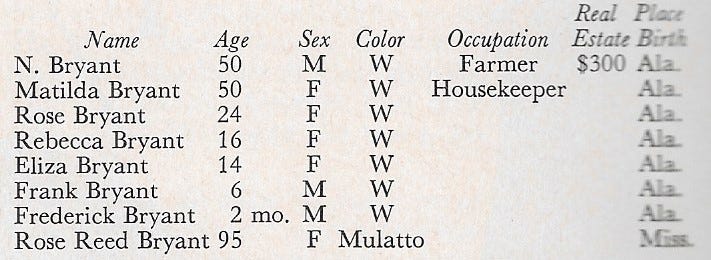
Apparently King was not terribly concerned with whose blood was in whom. Bryant was white; his wife, the daughter of Rose and Daniel was light enough to pass for white, and the children were white. But this sort of color blindness would soon become rare in Alabama.
Fifteen years before Appomattox, the Alabama Legislature saw fit to classify a mulatto as anyone who was one-half white and one-half black. Two years later, in 1852, the Legislature extended the term mulatto to the fourth generation from the original “Negro blood.” By the eighteen-seventies, the tradition of racism was abuilding and the carpet-baggers were busy in the South, seeing to it that wounds opened during the Civil War would not soon heal.
The Reed clan was growing. Generally speaking, women found it easier than men to marry outside the Cajun community and new names (and new blood) were being added. But as its sense of isolation from both whites and Negroes grew, it turned increasingly inward. Marriage records of the late 19th century are filled with instances of Reed marrying Weaver; Reed marrying Reed. The names appear in both the white and the Negro marriage books in the Washington County courthouse. Some of the Cajuns, anxious to be affiliated with the dominant white society rather than the oppressed Negro, began insisting to clerks that they be listed in the white book. If they were white enough, they made it, thus taking a step toward establishing themselves in a race. The darker Cajuns found the label “Negro” thrust on them. Members of the same thus found themselves classified in two races and inevitably, the lighter members pulled away from the darker members. The Cajuns were literally ripped apart by Alabama’s policy of segregation.
In all probability, the first few generations of descendants of Rose and Daniel married whites with some frequency, since there is relatively little evidence of Negro ancestry apparent today. The Cajuns also believe that there was a great deal of intermarriage between those early ancestors (who were not yet called Cajuns) and the Indians who lived north of Mobile, who were Choctaw.
Then, in 1886, something happened to infuse new blood into the people of mixed parentage who lived in upper Mobile and Washington counties, but it is virtually impossible to assess its importance. Some Cajun say it was very important. Some of them claim they are descended from Apache Indians.
The Apaches, of course, were a Western, not an Eastern tribe. By the eighteen-eighties, the Apaches had become a sizable problem for the United States Cavalry. Geronimo, after breaking with Cochise, decided to bolt the White Mountain Reservation in Arizona, and he led his Chiricahua Apache warriors into banditry. Between 1881 and 1886, Geronimo and his braves were blamed for the deaths of 100 American settlers in New Mexico and Arizona. The cavalry finally caught up with him in the Sonora Mountains of Northwest Mexico. The Apaches were relocated several times before their permanent settlement at Fort Sill, Oklahoma. At one point, they were taken to Fort Stoddert, a dusty encampment just outside Mount Vernon, Alabama, about 30 miles due north of Mobile. Geronimo was the first illustrious visitor Fort Stoddert had received since Aaron Burr had been kept prisoner there, 80 years before, suspected of treason. Burr was at Fort Stoddert for just two weeks; Geronimo was there longer. His braves grew restless. A lot of them made their way past indifferent Army sentries and headed for the tall pines, an area inhabited by many Reeds and Weavers. The story is that when Geronimo left Stoddart, he had fewer braves with him than when he went in. It is impossible to say just how many Apaches started living with Cajun women. Traditionally, the Cajuns have been a religious people and their sensuality has always been curbed by a sense of propriety and a belief in the solidarity of family life. But the visual evidence today of Indian blood is there for anyone to see. On Highway 96, the two lane strip that runs across the top of Mobile County from Mount Vernon to Citronelle, you find many people with the prominent cheekbones and the chiseled faces associated with the Indian look. Sometimes, the people in Cajun country show trace of all three racial types; their good looks are striking.
Rose Reed was a powerful woman and while she lived, the Reed clan rallied around her, a matriarchy content with raising cattle and chopping down the tall pines that then grew in such abundance. She made her last public appearance at a summer outing in 1875—she reckoned then she was at least 110 years old—and died two years later. Her will, still in the Washington County courthouse, was probated in 1878, and while some of the language may be that of her clerk or lawyer, Rose Reed’s dynamism is there, too:
“Almighty God the Giver and Taker of all things that be, Thy Righteous will have won for all men to die and afterwards to Judgement.
“First, I commend my spirit to God who gave it, my body to my friends to be buried in a Christian burial ground, Amen.
"Touching my worldly estate that God has pleased to bless me with. First, after all my burial expenses are paid, it is my will and my wish that my stock of cattle and hogs be equally divided among my several children viz.: Judy, Eliza, George, Matilda, Rubin, Emeline and William.
“My further wish and wish is, my dwelling, land, and premises, and kitchen, and tenements be appraised and for one of my children to take it at the appraised value and pay the other heirs a proportional share of the appraisement. It is my further will and wish that whatever my above named children or grandchildren may have heretofore received shall not be charged against them in the division of my estate. It is my will and wish that my children make this division among themselves, but if any dispute should arise among them to choose three disinterested men and let them make the divisions for them. In witness whereof I have hereunto set my hand, affixed my seal this 19th day of September, 1873.”
The Cajuns who now live in Southwestern Alabama sometimes speak of “Aunt” Rose but her memory is fast vanishing. Aunt Rose wasn't as white as she might have been and the Cajuns have difficulty in seeing what advantage there is in claiming a relationship.
Alabama's preoccupation with the definition of racial purity continued and now the Cajuns, with no Aunt Rose to turn to, were confronted with an accumulation of legal mumbo-jumbo that turned hard-working ranchers and woodsman into outcasts. It was toward the end of the 19th century that the Reed Clan began being called Cajun. The name, it seems, was a product of the mind of Alabama State Senator L. W. McCrae, who once saw the Louisiana Cajuns and concluded the people he knew back home ought to have the same classification.
In 1896, Alabama redefined its statute on mulattos once again, extending it down to the fifth generation from a Negro ancestor. Finally, in 1927, the legislature changed the term to mean any person descended from a Negro, no matter how many generations removed. Repeatedly, the Cajuns were reminded of who is white and who was almost white. They were reminded during the nineteen-thirties, when well-meaning churchwomen came up from Mobile, women determined to bring the word of the Lord to a people who suffered a hurt every time a flower-hatted female went by in a Model T and said, “There's one of them.”
One of the most graphic rebuffs came 38 years ago, when Mrs. Barbara Young, a direct descendant of Rose and Daniel Reed, tried to get her children into a white school in upper Mobile County.
Judge J. Blocker Thornton described why anybody descended from Rose Reed was not eligible to go to a white school:
“Rose Reed’s offspring of 1/2 black and 2/2 White will be 1/2 of the 1/2 black portion, or 1/4 black: The offspring of the 1/4 black and 4/4 white will be the 1/2 of the 1/4 black or 1/8 black: The offspring of 1/8 black and 8/8 white will be 1/2 of the 1/8 black or 1/16th black: the offspring of the 1/16th black and the 16/16 white will be 1/2 of the 1/16th black or 1/32nd black: The offspring of the 1/32nd black and the 32/32 white will be 1/2 of the 1/32nd black or 1/64th black. If we take for granted this analysis be true, these children are 1/64th black and 63/64th white, or going back to the starting of this analysis, out of 63 white ancestors, one, or the 64th ancestor, was Negro.”
Mrs. Young had maintained that Rose Reed was half Choctaw and half white, and that Daniel Reed was in reality a Spanish sailor. Whatever they were, Judge Thornton felt pretty clearly that Mrs. Young's children would be out of place in a white school.
U.S. Supreme Court decisions to the contrary, the white / black / people-in-between school system in Alabama was totally intact until last September. Then the counties were placed under court order to desegregate immediately. Three years ago, only a few Cajuns were escaping the segregated system by going to the Murphy or Vigor high schools in Mobile, provided they were white enough to pass inspection. Now most of the Cajun children have been integrated into schools in their area but the whole business remains in a state of flux. Some white parents are talking about starting private schools to “protect” their children and one has already commenced operation in the First Baptist Church in Mount Vernon. When I first visited Reed’s Chapel school early in 1967, I found it did not teach chemistry, physics, Spanish, French, German, agriculture, home economics, automobile mechanics or any other vocational skill. Now I find that as of last fall, it has begun to offer chemistry but still no physics; Spanish (but no one elected to take it) and still no vocational courses, except for a survey which tells children about what the opportunities are in many vocations or professions—although no actual training is offered in anything.
In 1967, one out of every two students did without books at Reed's Chapel school. The school spokesman now says that about 20% of the students do not have all the books they need, although every student has something. As in 1967, the school is still providing hot lunches and for 30 cents, a youngster gets 3 ounces of meat (frequently a wiener), peas and/or cabbage slaw, milk, Jello or maybe a canned peach. This is, in some instances, the best meal he is apt to get. The school may close next fall as integration efforts continue.
Although some Cajuns display unbounded hatred for the Negro, and I was told three years ago that Cajun children would—if forced to integrate—have a bad time with the blacks, it has not worked out that way. In the integrated high school in Citronelle, for example, Cajun youngsters are reportedly doing well.
Contrary to what some of their critics say, Cajun young people do not present much of a problem to the keepers of the peace. A deputy sheriff said that the most serious offenses seem to be sipping a little moonshine now and then or drag racing on back roads. Nor do their elders cause trouble. A check of welfare records show few Cajun names, few instances of family desertion by the head of household. Cajun families remain close; they have to. My first visit to a Cajun school was a vivid experience. I parked my car on the rim of a recreation area. Eyebrows went up; few outsiders visit the Cajuns. About 30 children suddenly rushed out the door for an exercise period. They lined up and the teacher called the roll. Half of them answered to the name of Reed. Then it was lunch time and more children came out. White children, brown children, tan children, golden children, blonde children with kinky hair, dark children with straight hair, thick noses and thin noses and noses in between, red hair and freckles with a hint of Africa, a hint of Apache, a hint of some 19th century white man who needed a wife more than he did assurances of racial purity in his children. Tectonic blue eyes looking at me over Indian cheek bones, bright of eye and bursting with life; beautiful children.
And the women. On the road to Citronelle, a dark blonde with green eyes and golden skin and white teeth. When they are 17, they are the most beautiful women anywhere. If they were in London or Paris or even New Orleans, aging businessmen would stare reverently and college boys would know how Gaugin felt when he hit Tahiti. But this is not London. This is the red dirt of Alabama, where Cajun girls marry early and families of a dozen are not uncommon. Soon the green-eyed, dark-skinned blonde on the road to Citronelle will not be 17 anymore but 25, and the lopsided diet of cornbread and sowbelly will take its toll. The soft arms become very hard indeed.
“Some of them Cajun gals, they is kind of cute, if you know what I mean,” a white business man told me. They look damn good when they're young but as but when they get to be 25 or so, most of them is ugly as sin. I don't know why. I suppose it's because them people don't know how to live and that is why they is where they is.” Said another white man, a lawyer in the Washington County seat at Chatom: “They ain't so bad. Why most of them are 15/16 white, anyhow.”
Confronted daily by a white establishment than never tires in it's relentless pursuit and detection of racial tarnish, the Cajuns have become a clan that is prideful when it is turned inward, defensive and even ashamed when it deals with outsiders. It is patently racist on the subject of Negroes. At a Catholic Church in the Cajun area, I went looking for the priest, Father John C. Crotty. “He ain't here now,” says a dark-eyed girl who's great, great grandfather might have been an Apache Warrior. “I think he's with the niggers. He's got a nigger church over by Chastang. He don't come around here much. Mostly he stays with them.”
The Negros who live near the Cajuns generally avoid them because they seem to take comfort in being black, because in Alabama being black is surely more secure than racial anonymity.
“The Cajuns is something,” said a Negro lumberjack. “They ain't white and they ain't black. They ain't nothing.”
Some whites in Alabama have real compassion for the Cajuns. There are other whites in Alabama who say they have compassion.
“Gracious me, yes,” said a white banker. “Why we had one of them in my class in high school and we treated him just like he was white, too. Of course, nobody bothered with him after school; you couldn't expect us to. And the girls stayed away from him. But outside of that, we treated him just like he was one of us. There's more integration in the South than the Yankees understand.”
The banker even produced a high school paper he had written on the Cajuns back in 1932 and his conclusion evidenced on the depth of his understanding.
“Our problem,” he wrote, “is to keep them from intermarrying with our whites of low mentality—to keep them from wandering off to new fields and posing as white. Just how this can be avoided has not been decided—in my opinion there is no solution; just trust the next decade will not see them multiply as fast as the last.”
The paper received a grade of A; and to this day the banker has a reputation as a man who really understands the Cajuns. Indeed, his name was given to me by a source who had never met him but knew of his expertise. And yet somehow, the white banker and people like him have failed to bring out the best in the Cajuns. Somehow, they don't seem to take much pride in their identity. I saw a boy in the woods one day. He had red hair and blue eyes and would have been a hit in Dublin.
“Hi,” he said. “Where you going?”
“Oh, I thought I’d just walk a ways towards McIntosh.”
He walked with me for a while along Highway 35. He said he knew where the big fish were in the Tombigbee River. Trying hard to be matter of fact, I asked him if he had ever heard of Rose and Daniel Reed.
“Never did,” he said. He turned and vanished into the woods.
For employment, the Cajuns continue to get most of theirs in the piney woods, where they chopped down trees for the big paper companies, such as Star and International, north of Mobile. A non-Cajun will make a contract to supply wood for the paper mills. He will subcontract the job out to a Cajun and perhaps even rent him power equipment and trucks for a good price. Other times, a Cajun will use his own beat-up truck.
But what frequently seems to happen is that the cost of renting equipment seems to exceed or equal what the Cajun can expect for his labor. Moreover, even a Cajun with his own equipment will show up with half a dozen of his relatives. If he receives the minimum wage for such labor he must then distribute it among his relatives with the result that Cajuns have actually worked a week for as little as $10 or $15, which may be one reason why they eat a lot of sowbelly in southwestern Alabama.
As for the paper mills, they couldn't get a more profitable arrangement in Bulgaria. The accounting is simple and there isn't so much messy paperwork if a tree falls in the wrong direction and splits a Cajun’s skull open.
In the last few years, the Cajuns have grown more and more dissatisfied with this arrangement. There are now Cajuns working for the Geigy Chemical Corporation near McIntosh, which they say cracked only after maximum effort. A few years back, Geigy wanted them to work with the negroes. They refused and got no jobs.
Cajuns claim they're having a great deal of trouble in getting jobs at the Olin Mathieson plant near McIntosh as well as the Shell plant near Salco. Both organizations have Negroes on the staff.
Now they are coming out of the woods. Now you can see the Cajuns coming down Route 43 for jobs in the Mobile shipyard, where they make more than $3 an hour.
One Cajun looked at me proudly and said: “We have 25 of our people just from the Calcedeaver area in the shipyard.” But then he added, “Of course, there's a lot of work there now. When they start laying off, our people will be the first to go. We don't have the seniority.”
But still they come. You can see them, driving or hitchhiking through Chastang and Bucks, through Creola and Satsuma, down past the Stauffer Chemical Company plant, down past Cold Creek, Sister creek, Chickasaw Creek and Black Bayou, all the way into Mobile to weld and to bring back $100 at the end of a week.
But even when they succeed in the outside world, they do not escape the scorn of others, white and Negro alike.
“The one theng ah ain't able tuh unnerstan iz th’ way them cedduh choppuhs talks Ainglish,” a white lawyer said. “Them cedduh choppuhs got the oddes’ way uh pallaverin ah evuh did see.”
A former worker among the Cajuns summed them up in this way: “If they don't know you, they will tell you what they think you want to hear. They have no reason to trust you. If they like you, they'll die for you. If you cross them once, they will never forget it. Don't expect them to tell you about Rose Reed or the old superstitions. Don't expect them to be understanding about Negroes; there is no reason why they should be. Negroes have organizations helping them. Nobody's helping the Cajuns. The Cajuns will tell you they don't need any help. They are all alone. You know, the blacks sometimes say we can't really understand how it is unless we are black. I think it must be twice as difficult with the Cajuns. They feel a terrible hurt.”
“The point is,” one Cajun told me, “that we have to get our heads out of the sand. If we are ever going to grow up, we have to find out who we are. We have to admit that we are not pure white. That is a terrible thing to have to admit in Alabama. If you write something, you're going to hurt us. Maybe temporarily you will set us back. But in the long run, we must accept the truth and take pride in what we are.” Asked if this meant even accepting the fact that there might be Negro blood in some Cajun families, he said: “Even that.” But another Cajun called me the night before I was going to leave Mobile. He said he was a bright man and devoted to his people. He said: “Say what you want, but if you care about these people, don't say we're colored.”
And so the Cajuns go on, with a 50 per cent illiteracy rate among adults, poverty level wages, mental and physical problems that are becoming worse with each passing year, and a deeply rooted dislike of the black man—a way of thinking thrust on them by the whites which they pass on to the blacks.
The Cajuns are not unique. America's filled with hybrids—people of white, negro, and Indian ancestry. They’re sometimes called half-breeds, sometimes half-niggers, sometimes white trash. America now affords a classic study in group defensiveness; minorities are finding they have to join defense groups and go on the offensive, just to claim their share of the national wealth, their birthright as Americans. But the Cajuns and groups like them are not joiners. They are staunchly independent and so easy for the establishment to ignore. They are small in number, poor, ignorant of what it takes to succeed in this over-organized society and they are alone.
The list of The People in Between is a long one. Tennessee has its Melungeons, New York its Jackson Whites, Delaware its Moors. There are Dominickers in Florida, Croatians in South Carolina, Wesorts in Maryland, and Narragansetts in Rhode island. Some are a white-Negro mix; some are white-Indian; others are mixes of all three. Almost all are set apart from society and are getting the very shortest part of the short end of the stick. No National Association for the Advancement of Colored People cries out for them; no Anti-Defamation League of B’nai B’rith champions their cause.
Perhaps one day the Cajuns of Alabama will be able to take justifiable pride in Rose and Daniel Reed. Perhaps when they find out who they are it won't matter to them so much that America's tradition of social justice as eluded them. Alabama is changing; the Cajuns have more friends than they know. But not as many as they need.
-Robert Severo
Approximately $8,371 in 2025.
Approximately $82,000 in 2025.