


Quick Links
STRIKE IS OVER
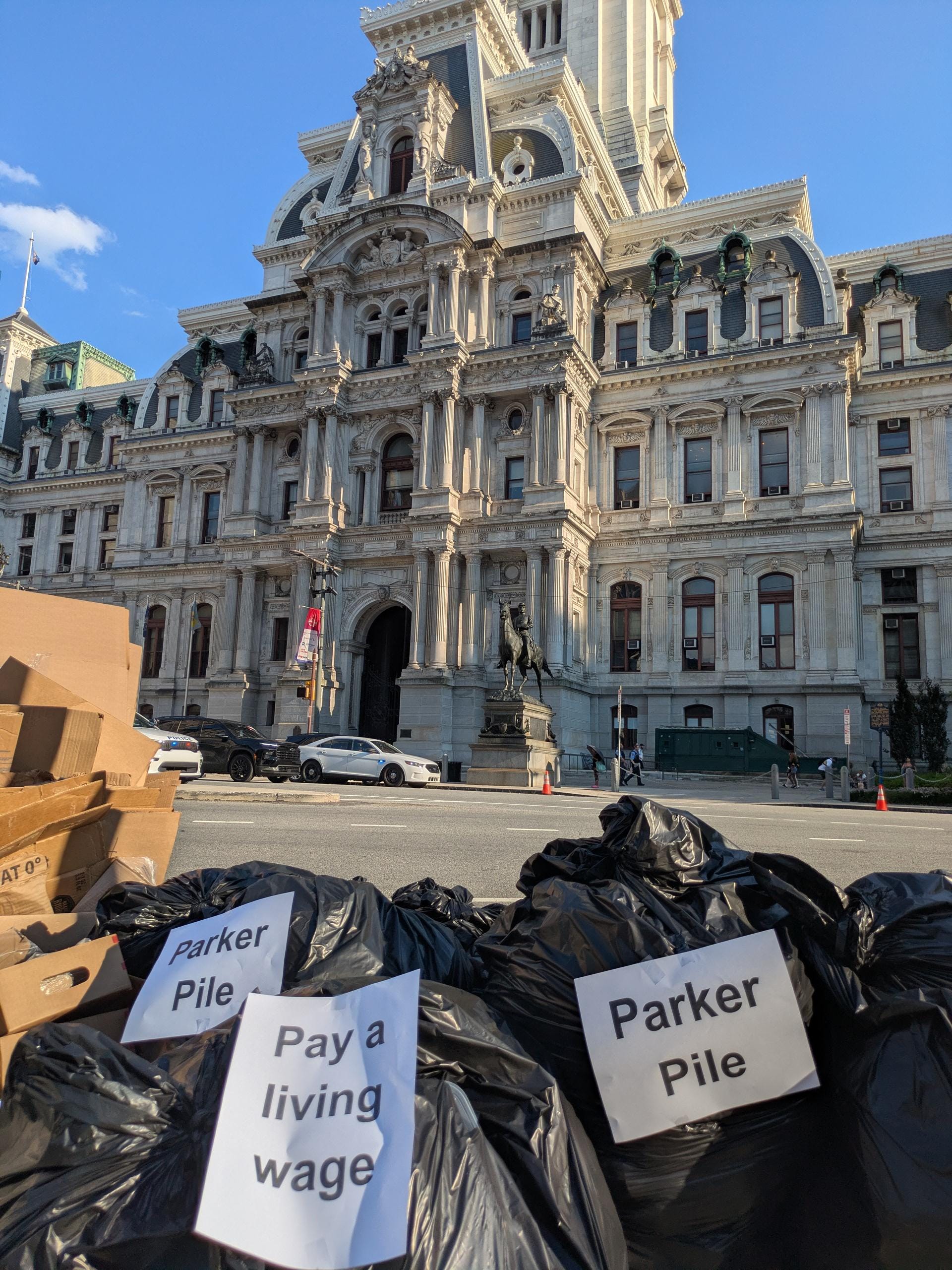
Philadelphia’s first major city workers’ strike since 1986 ended after eight days when Mayor Cherelle L. Parker and AFSCME District Council 33 President Greg Boulware reached a tentative, three-year contract agreement on July 9, 2025. The deal, covering about 9,000 blue-collar workers like trash collectors and 911 dispatchers, includes 3% annual raises, a $1,500 one-time bonus, and a new pay scale step boosting veteran workers’ wages by about 2%. The strike, which disrupted important services like trash collection, highlighted tensions between city unions and the Mayor’s office. Parker stated that her priority was fiscal responsibility, while the union stated that they were pushing for “a living wage.” The contract, costing $115 million over five years, awaits union ratification. The strike has strained Parker’s ties with labor allies, and available data suggests that the union has strong public support.
ROBOTAXIS COME TO PHILADELPHIA
Waymo, Alphabet's autonomous vehicle company, began "road trips" to Philadelphia and New York City to explore expansion from cities like San Francisco and into the Northeastern United States. These trips involve mapping new areas with human-driven vehicles equipped with Waymo’s self-driving technology, followed by autonomous testing with a human behind the wheel to refine the AI system. While similar road trips have led to commercial launches, such as in Los Angeles, Waymo’s activities in Philadelphia will cover complex urban areas, and in NYC, they will map parts of Manhattan, Downtown Brooklyn, Jersey City, and Hoboken. However, NYC’s regulations currently prohibit fully driverless operations, and Waymo is pushing for regulatory changes while awaiting approval to test with a human driver. These efforts build on Waymo’s existing robotaxi services in cities like Atlanta, Austin, and Phoenix, with planned launches in Miami and Washington, D.C.
STATEWIDE 911 OUTAGE
Pennsylvania's 911 system experienced intermittent outages on Friday but resumed normal operations by late that day, according to the Pennsylvania Emergency Management Agency (PEMA). The cause of the outages is under investigation, with no initial evidence suggesting a cybersecurity issue, as stated by Comtech Telecommunications, the state's contract provider. A full root cause analysis is underway, and an independent review will aim to prevent future disruptions; officials indicated that the outage was almost certainly IT-based. Most county’s 911 systems were reported stable by midnight Friday, with no further issues by Saturday morning. PEMA recommends residents save their county’s 10-digit nonemergency number for use during potential future outages.
IBX ANNOUNCES “EMPLOYEE BUYOUT”
Independence Blue Cross, a Philadelphia-based health insurer, offered buyouts to employees who started before December 31, 2020, as part of an effort to streamline operations amid rising medical and pharmaceutical costs. The company, employing 4,134 people under Independence Blue Cross LLC, said that they aim to build a “resilient” organization but did not disclose the number of employees offered buyouts or whether layoffs would follow if targets are not met. This follows a 3% staff reduction last fall and comes as the broader health insurance industry faces financial challenges, with Independence reporting a $239 million loss in 2024. The loss was the company’s first since 2015, driven by increased costs in Medicare and Medicaid plans.
SEPTA CRACKS DOWN ON FARE EVASION
SEPTA, Philadelphia's public transit system, is addressing fare evasion through a new enforcement “blitz” that has already shown promising results, with a 200% increase in sales at Huntingdon Station in Kensington since officers were deployed last week. The initiative, which involves stationing officers at various stations across the Market-Frankford, Broad Street, Regional Rail, and trolley lines from 6 a.m. to 6 p.m., aims to ensure all riders pay fares, reducing the financial burden on SEPTA and paying customers, especially as SEPTA faces budget shortfalls.
NO NEW MONEY FOR STADIUMS, SAYS GOVERNOR
Pennsylvania Governor Josh Shapiro announced that the state will not provide funding for new sports arenas, including potential projects for the Philadelphia Eagles, whose lease at Lincoln Financial Field expires in 2032, or the Pittsburgh Steelers and their stadium. Speaking at Pocono Raceway, Shapiro emphasized balancing investments in sports and tourism with other state priorities amid federal budget cuts. He confirmed ongoing discussions with Eagles owner Jeffrey Lurie and the Steelers’ Rooney family about their stadium needs but stressed no state funds would be allocated, as seen with the 76ers’ recent arena plans. Shapiro also highlighted talks about bringing a NASCAR race to a Philadelphia stadium like Franklin Field to boost the sport’s visibility while supporting Pocono Raceway’s economic success, which saw its third consecutive sellout. Additionally, he celebrated Pennsylvania’s 2026 sports lineup, including the NFL Draft in Pittsburgh, the MLB All-Star Game, the World Cup, and the PGA Championship.
PHILADELPHIA SCHOOLS FACE MAJOR OVERHAUL, CLOSURES
Philadelphia’s school district is nearing a major overhaul of its 300 buildings, with Superintendent Tony B. Watlington Sr. set to propose closing some schools, rearranging others, and renovating or building new facilities by Fall 2025, with school board decisions expected by year-end. The plan, guided by a facilities master planning process, evaluates buildings based on safety, accessibility, modern technology, environmental standards, program offerings, capacity utilization, and neighborhood vulnerability. The plan aims to address aging, unequal facilities and inefficiencies stemming from enrollment trends. Watlington emphasized reducing grade configurations from 13 to six, consolidating career and technical programs, and decreasing traditional middle schools to improve academic and extracurricular equity across neighborhoods. Community engagement sessions are scheduled through July 24, but advisory groups have raised concerns about incomplete data and the process’s transparency, with some urging a freeze on closures and a greater focus on maintenance to avoid repeating the negative outcomes of past closures in 2012 and 2013.
STINGING ASIAN ANTS MAKE NEW HOME IN PHILADELPHIA
The Asian needle ant (Brachyponera chinensis), an invasive species native to China, Japan, and the Korean peninsula, has been sighted in Philadelphia, with three confirmed reports on iNaturalist: May 2020 on Krams Avenue in Manayunk, July 2023 on Delaware Avenue, and April 2025 on Woodland Avenue in Elmwood Park. These small, shiny, dark brown to black ants, measuring about 0.2 inches, deliver a painful sting that can cause anaphylaxis in hypersensitive individuals, though the prevalence of such reactions in the U.S. is unknown. While not yet a major threat, their presence raises concerns due to their potential to displace native ant species and reducing biodiversity, like many other invasive species. Experts like Michael Skvarla from Penn State note that their prevalence in Pennsylvania is unclear, and more research is needed to assess their abundance. The ants, first detected in the U.S. in 1932, thrive in temperate forests and urban areas but are hard to control due to a lack of natural predators and the impracticality of widespread insecticide use. Homeowners are advised to seek professional pest control for suspected infestations to avoid exacerbating the issue.
PHILADELPHIA SCHOOL DISTRICT FIRST IN THE COUNTRY TO FACE CRIMINAL CHARGES IN ENVIRONMENTAL PROBE
The Philadelphia School District has entered a deferred prosecution agreement (DPA) with the U.S. Department of Justice following a five-year investigation into its failure to comply with federal asbestos regulations under the Asbestos Hazard Emergency Response Act (AHERA). The district, the first in the U.S. to face criminal charges for such violations, was found to have missed mandatory three-year inspections at seven schools and six-month inspections at one school between 2015 and 2023, affecting 31 buildings, some with improperly handled asbestos, like using duct tape for repairs. The agreement, approved unanimously by the school board on June 26, 2025, requires five years of court-monitored compliance, including regular inspections, remediation, and transparent reporting, with charges to be dropped if met. The district has tripled its environmental budget to $55.7 million, aided by a $100 million University of Pennsylvania donation, and now conducts twice-yearly inspections. Past underfunding and faulty record-keeping contributed to closures like Frankford High in 2024.
