


introduction
i got a fuckin papa johns order in my mouth as i type this. heil papa.
the people behind “poor things” (2023) have inadvertently made a master-class in right wing propaganda. this is not necessarily a perspective i endorse, but there’s something to be said when your worldview is so profoundly upside-down and your logic so bizarre that someone who speaks a completely different political language can see it and say, ‘yes, that makes sense, and i agree.’
and so, “poor things,” despite never trying to be so or having so much as a lick of self-awareness about what it is saying, is, now, a right-wing master-class in propaganda. i declare it so.
how? patience you bastard, i’m getting there.
i am not robert “pussy-getter” ebert. i am not writing this review because i like writing movie reviews. i am not writing it because i get paid to write movie reviews either, or because i get paid to write anything.
i am writing it because, as they say, “art reflects life,” and “poor things” speaks very loudly to the walking corpse that is the increasingly pervasive style of cultural nihilism we’ve come to know in these “united” states - one which states that freedom is a blank check and a complete rejection of inhibition as it tries to step over any semblance of conventional wisdom or boundaries to feast on the flesh. i think we can learn something from the autopsy. in its attempt to be a pop feminist story, it has in a rather hilarious manner instead become a right-wing caricature of a pop feminist story. the film romanticizes exploitation, blind compulsion, and “sex work” as freedom like it’s gospel, but it’s so tone-deaf it could be a satire - except it’s not laughing.
so, kudos to them for that, i suppose.
cathedral of kink
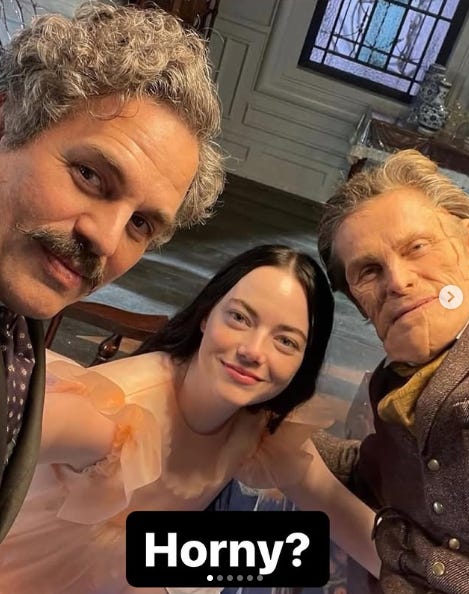
a little exposition: “poor things” introduces us to bella (played by emma stone), a “frankenstein”-style fever dream monster stitched together by the mad scientist dr. godwin in Victorian London (played by wilhelm dafoe) who has jammed the brain of a fetus into an adult woman’s body.
godwin ropes in student max mccandles (ramy youssef) to study her like a lab rat. max falls for her, but sleazy lawyer duncan wedderburn (mark ruffalo) bangs her senseless instead. she’s now obssessed with sex, tells godwin and mccandles to fuck off, and jets to Lisbon with wedderburn for a booze-drenched sex fest. it’s a circus. her brain rapidly grows, and when emotionally overwhelmed by the poverty she witnesses at one stop, she gives away all their money to thieves in a hapless stab at charity. with no means to pay for the rest of the trip, the crew leaves them stranded them in France penniless, and with no way to get home, their relationship crashes and burns.
finally, bella wises up and ditches the boorish weddernburn, bringing us to a pivotal point in bella’s development during the film. so, how does she get revenge on this jerk?
maybe the film acknowledges as part of her growth that perhaps she was wrong to follow her most primal instincts and that such things will not lead to happiness? does she realize the effects of her decision to suddenly leave the people that loved her and that her initial judgements were wrong? anything to mirror her cognitive development as shown during her cruise with weddernburn?
no, the film takes a very different route. instead, she enthusiastically becomes a prostitute.
“A woman plotting her course to freedom,” says Madame Swiney, the brothel owner. “How delightful!”
i could probably take 4,000 mgs of mescaline and still not come up with a theme as delusional as this.
as bella bucks off one male’s control over her sexuality, she becomes beholden to an arguably much worse master, and the film seems to smirk like it’s a win because it goes against the rules. living in Paris, bella’s evolution kicks into overdrive, propelled forward by different sexscapades, and bella’s morals resembling something along the lines of: “do what you want if it makes sense, regret’s just a Victorian hangover.” follow this roadmap, and it will lead you to your truest self, somehow.
but we know that’s not quite true - take the one brothel scene, for example. bella, a seasoned pro by now, has an epiphany when a particularly crude-looking customer is choosing girls from the brothel lineup:
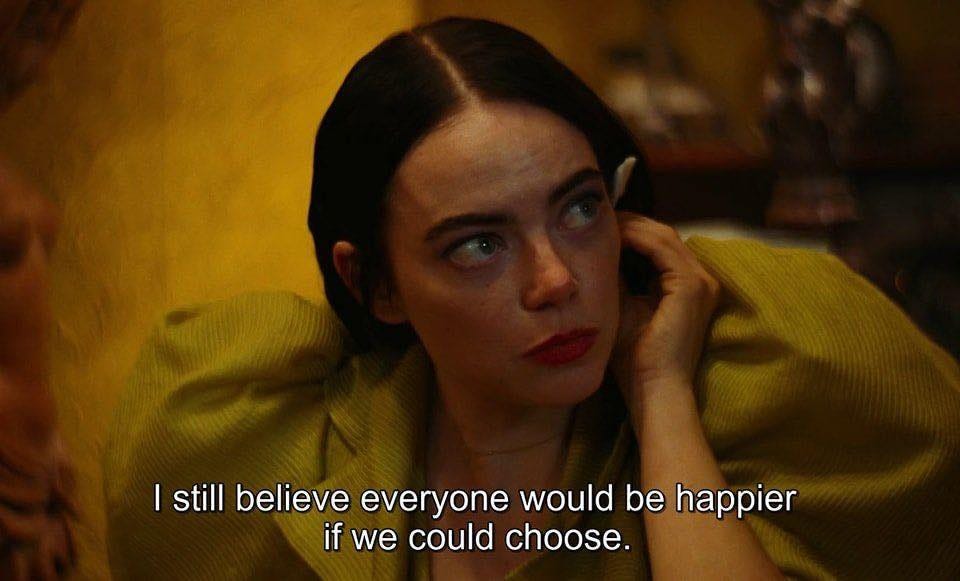
“So would you not prefer it if the women chose, as it would be a sign of enthusiasm toward you?” bella says, landing a blow for the girls.
the customer’s smile fades.
“You wouldn’t have the vague sense that they are in a state of horror when they jump you?”
she launches into science-inspired speech about how things are the way they are until people change them and then they are not.
“As a socialist, I agree entirely,” says one of the other prostitutes. “Formidable.”
Madame Swiney shuts this down fast.
“We are a machine you feed with compliments and chocolate,” bella gripes later to the Madame.
what’s the play here: is she empowered, or exploited? are the girls in control of their sexuality, or are they cogs in a machine? the movie can’t seem to decide. let’s explore this a little more: as a human in modern western society, you are free to do what you want and fuck who you want to fuck. violating this rule - the crime of rape - is punishable by a number of years in prison in most places or, up until recently, by death.
this is a bit different if you are prostitute who accepts money in exchange for sex. you’re selling you, and you’re still beholden to most of the same economic traits apples or cigarettes are. no, you don’t have to sell to anyone under 21, but you also can’t be too choosy about who buys your product because at the end of the day you want to pay rent. your sexuality has reins attached now: you will have sex with men you don’t like, they’ll sometimes ask you to do strange and eccentric and disgusting things, and they may not be particularly interested in learning about what gets you off in bed. but their money is just as green as anyone else’s.
this isn’t a rant on what prostitutes should do - just a grim description of their economic reality. this type of dissonance we see in the film - prostitution as a stage of freedom for bella versus the obvious cage it builds - is a part of what makes it so confusing in its message. such scenes land so badly in the point they’re trying to make that it’s hard to not do a double-take and check the credits to make sure you’re not watching a Daily Wire parody production designed to own the libs.
while the film attempts time after time to desperately display how enlightened bella is and how she is on her path to becoming her own woman, it’s instead shown how bella’s situation is perhaps the least freeing thing someone can do for their sexuality. bella doesn’t seem any closer to finding her truer self, from where i’m sitting. sure, you might be shoving it to the morals of a prudish society, but work sucks - this is still true if you’re a prostitute.
"Worst of all, it's dishonest,” says Mick Lasalle of the San Francisco Chronicle. “It purports to be a feminist document, but it defines a woman's autonomy as the ability to be exploited and not care. ... What version of feminism are these guys—Lanthimos and screenwriter Tony McNamara—trying to sell us here?"
you could spin these experiences as something bella had no choice in (“a confluence of circumstances,” as bella might say) - but that doesn’t really vibe with what the film is trying to sell.
for one, if it’s not a choice, then how is it a step in liberation? furthermore, the movie shows how she insists she doesn’t need to prostitute herself to live, but does so because she finds “the experiment” amusing. all the while, bella is scribbling letters to godwin regularly (though i would guess not giving him all the details) - and there’s no clear explanation of why she couldn’t return home at anytime if she wanted.
party like it’s 1899
even with all its intercourse and nudity and themes of sexual discovery, the film isn’t even really about sex - it’s about dopamine. the screenwriters have bella baxter chasing sex like a junkie hunts a vein. her journey is supposed to be how she uses sex to discover her identity, yet she takes on every greasy cretin that stumbles into her orbit. she’s a rebel alright - her outburst about choice, for example, or her boldness in telling the patrons they reek - but bangs them anyway, like a fiend tweaking too much to care what might be in the needle. in this way, her odyssey to discover her identity as the movie would seem to portray it takes on an oddly chauvinistic bent: the only quality of the female identity, as explored by the movie, is soulless sex without boundaries, and not much else. duncan’s personality makes her gag, but she’s grinning like a jackal while he pumps away - another hit, another high. The customers she’s tangled with are much older than her, with faces resembling melted wax and bodies that look like they came out the stomach of a vulture. if you really wanted to scare someone from saying anything positive about sex work, you’d do it like this.
no spark, just the raw, sensory jolt of flesh on flesh, an addict’s fix with no soul or love behind it. it’s a grotesque fantasy of a woman’s sex life, and it begs the question - why does the movie attribute to male desire things like attraction or the pursuit of something worthy to be chased, while bella’s libido is portrayed as a faceless slot machine spitting out quarters for any drooling frenchman with a pulse? for bella, the story tells us there’s nothing more to sex than the mechanical, physical act. this seems less like liberation, and more like dehumanization.
but men in the film aren’t totally safe from such reductions either: later in the story when bella and mccandles are to be wed, her war-dog husband from her previous life, general alfie blessington (played by christopher abbott) crashes the wedding. we’re introduced to yet another unsavory male jockeying for control of bella, and she once again makes the questionable decision to relinquish control to this person.
ironically, it’s male characters like these that seem to be the only thing that keep the movie going, and the constant revolving ensemble of cartoonishly evil men acts as its crutch. the masculine element reliably takes on a demonic quality and bella only really exists in the context of these masculine characters trying to do things to her. despite its attempts to be a feminist movie, the writers create a movie utterly beholden to the actions of men - even when it doesn’t really have to be - and female characters without agency.
perhaps the most direct attack on female agency in the movie, and sexual agency in particular, is when her husband plots to have a doctor surgically remove her clitoris:
“My life is dedicated to the taking of territory. You are mine, and that is the long and short of it,” explains bella’s soldier husband, martini in one hand and gun in the other.
“I am not territory,” bella replies.
“The root of the problem is between your legs. I will have it off, and it will not distract and divert you anymore.”
such dialogue is repetitive, uninspired, and, by the end of the movie, has you thoroughly ready to put your head through a wall. if you couldn’t grab the premise of the movie already, such conversations hit you over the head with the all the points the writers are trying to make; fuck nuance.
you could probably shoot someone point-blank in the face and still not be as on-the-nose as this movie is in attempting to expound its philosophy. all in a few short sentences, they often manage to cram in ideas that men believe female sexuality is evil, men only know how to use force to get what they want, men think women should be baby-making machines, and, all the while, all women want is to be free and themselves.
anyways, without going into too many details, the husband problem is eventually creatively solved. the movie ends with a serene scene of bella, presumably having achieved self-actualization, in godwin’s garden studying for an anatomy exam with mccandles so she can become a doctor. the camera cuts in close on a shot of her poring over book pages as a smile cheekily breaks the corner of her mouth.
but wait a minute - a woman studying to become a doctor in the same primitive, male-dominated society that was ready to chop off her clit? sure man, who even fucking cares anymore at this point.
by the end of the story, the movie’s attempts to affirm itself as a film of logic, liberation, and a rebuke of male domineering falls flat owing to the various nonsensical and confusing inconsistencies of its message. under the hood, it doesn’t appear much more than a film draped in the emperor’s new clothes, and that’s the real sad lesson here.
postmodernism’s smug frankenstein
“poor things,” with all its surrealism, is not simply some bad feminist acid flashback, but a full-fledged right-wing, fifth-column propaganda victory.
squint the right way, and bella’s “liberation” is a cautionary tale. she’s a naive blank slate, brain of a fetus in a woman’s body, who bolts from the protective arms of fatherly godwin and knightly mccandles - stand-ins for tradition, science, and good ol’ patriarchal guidance, if you choose - into the arms of a sleazy libertine. what’s her reward? a booze-soaked sex fest that leaves her broke, stranded, and trading her body for francs. the film doesn’t flinch from showing her freedom degrading her. it’s as much a journey into discovery as it is a spiral into chaos, a neon sign screaming, “this is what happens when you ditch restraint for reckless liberty.”
and the clincher? the movie never lets bella’s choices stand as noble rebellion. Her charity stunt - tossing wedderburn’s cash to thieves - doesn’t uplift the poor, it just screws her harder. her brothel epiphany about “choice” gets slapped down by Madame Swiney, and she’s back in the machine. every step she takes away from the structure of godwin’s lab or mccandles’ devotion seems only to land her deeper in the muck, preaching that without guardrails, you’re not free, you’re roadkill. by the time she’s studying anatomy at the end, it’s less a feminist win than a quiet return to the fold - saved by the inspiration of men she once spurned, poring over books like student of the month. the film’s so busy smirking at its own clever rebellion it doesn’t see the sermon it’s accidentally preaching: abandon tradition, and you’ll end up a soulless cog in a flesh factory.
that’s what i imagine someone like ben shapiro would say, anyway. no interpretation of a film is “wrong” per se - but the badly-managed version the director’s shown us is so riddled with holes, you could claim practically anything about it and still sound plausible. it very well may be the first film with negative amounts of self-awareness.
but one thing “poor things” does get right is that itself, and probably american society in general, has an addiction problem. drugs, sex, rage, violence - whatever gets the chemistry flowing. and not unlike many addicts, it refuses to admit it has a problem. it thinks that being emotionally out of control is the definition of freedom. it dresses up bella “chasing the dragon” and her sex without desire as a story of liberation.
when godwin attempts to rein in bella’s childlike emotions through the mildest sense of parental control and responsibility, the story rebukes him:
“I cannot let you go,” he says when bella tells him she’s running off with wedderburn.
“Kiss me and set me forth,” bella responds. “If you do not, Bella's insides shall turn rotten with hate.”
“Hate?” he says, dismayed.
this refusal to say no, of course, sets bella off on her journey to enlightenment. impulse, emotion, and weakness wins the day, and never once does bella seem to face any serious criticism from the film for all her missteps.
this decision tracks: from the beginning of the film, the movie paints her as a being of pure logic - the mind of a baby but the power of an adult, soaking in all the ideas and experiences of the world like a sponge in order to come to the best ones and reach total enlightment, nirvana. subsequently, any conclusions she reaches are supposed to be correct, and you, the viewer, with all your preconceived notions must be stupid for thinking otherwise. it uses various means to tell us when we should to be cheering bella on, not unlike a production assistant holding up a cuecard to tell a studio audience when to laugh. frequently, this device veers off into the preposterous:
“does the whoring challenge the ownership that men desire?” she asks mccandles, as if it were an outrage to have reservations about a woman who had unprotected sex for money and ignoring the fact that the story takes place in Victorian England - well before the invention of penicillin for “the clap” or anything else, mind you.
“your body is yours to give freely,” says the thoroughly progressive mccandles.
the entire movie is essentially one giant pat on the back. Manohla Dargis of The New York Times sums it up nicely: “It isn't long into Poor Things that you start to feel as if you were being bullied into admiring a film that's so deeply self-satisfied there really isn't room for the two of you."
“poor things” doesn’t have much guts, either. it avoids with a ten-foot pole the very real consequences of things like prostitution or addiction - something that could have brought raw and emotional complexity to the story. it just seems ludicious: for the most part, bella prances through, unscatched. “poor things” never chooses to describe through bella the feelings of shame and self-hatred many prostitutes feel, even temporarily. it never touches on the damage it does to many in the way that post-traumatic stress disorder is the norm among prostitutes, the sexual and physical violence these women face in this line of work, or how it affects future relationships with men and children. and all these effects largely do not discriminate; most of them are true of both the lowest sex slave in the third world and high-class escorts in New York penthouses.
i would also argue that “poor things” is a symptom of a disposable society, with those of us calling the 21st century home only knowing disposability. plastic candy wrappers, cheap lego-like ikea furniture, social validation from the tap of a screen on social media - none of it lasts. and now, sex.
“…your odes to my beauty have been boring but constant. and the simple act of letting a strange man ride on me [in exchange for money] has erased all that,” says bella.
“Fuck! You whored yourself,” replies weddernburn.
“And you’re going to explain to me why that’s bad?” says bella.
it’s a conveyor belt conception of freedom - men, beds, cash, repeat. bella’s sexual activity is a long line of replaceable men. what could have been a sharp satire on creation, identity, and/or societal decay instead devolves into a tedious celebration of some type of twisted materialism - everything is transactional, nothing is human.
jesus, and i thought i was insufferable.
taking a holistic view, the movie’s not all bad - the actors kill it, the cinematography is admirable, and the visual effects fantastic. the premise itself - ripped straight from the pages of a Victorian gothic novel - is enticing. the movie is quite humorous at times, too - but unfortunately, not much of this matters when the fat, putrid heart of your story sucks ass. lanthimos seems to think that slapping a feminist label on this parade of flesh - bella’s liberation through orgasm - makes it subversive. it doesn’t. it’s a cheap trick.
and that’s the crux of the problem: “poor things” desperately wants to subvert in its portrayal - ideas of control, women, stale traditions, villainous and suffocating men - but it’s a swing and a miss that slips past the other boxer in the ring and instead hits the ref square in the face. bella’s journey starts in a lab and goes on to roll down a factory line of consumption and sex - not an imperfect metaphor for a capitalist (perhaps post-humanist?) world that treats people as interchangeable parts. yet the film never dares to interrogate the story like this. instead, it drapes itself in dazzling visuals and says “this is fine,” as if a few grotesque surgeries and some whimsical set design can mask its contradictions. the result is a disposable product about disposability, too enamored with its noble prose to notice the irony, a reflection of a society so obsessed with instant gratification that it can’t even muster a coherent critique of itself.
there is no need to dress up female sexuality in an elaborate, flowing philosophical dressing that only ends up dehumanizing them. we’re all brutes - who cares?
“you smell okay,” bella says, as if she were checking milk from the refrigerator.
“let us fuck.”
“poor things” is a poor thing indee - hey, you fuck, give me that garlic knot.