

no clear exit
dispatches from the frontlines of Gen Z romance & the great american situationship | OPINIONS

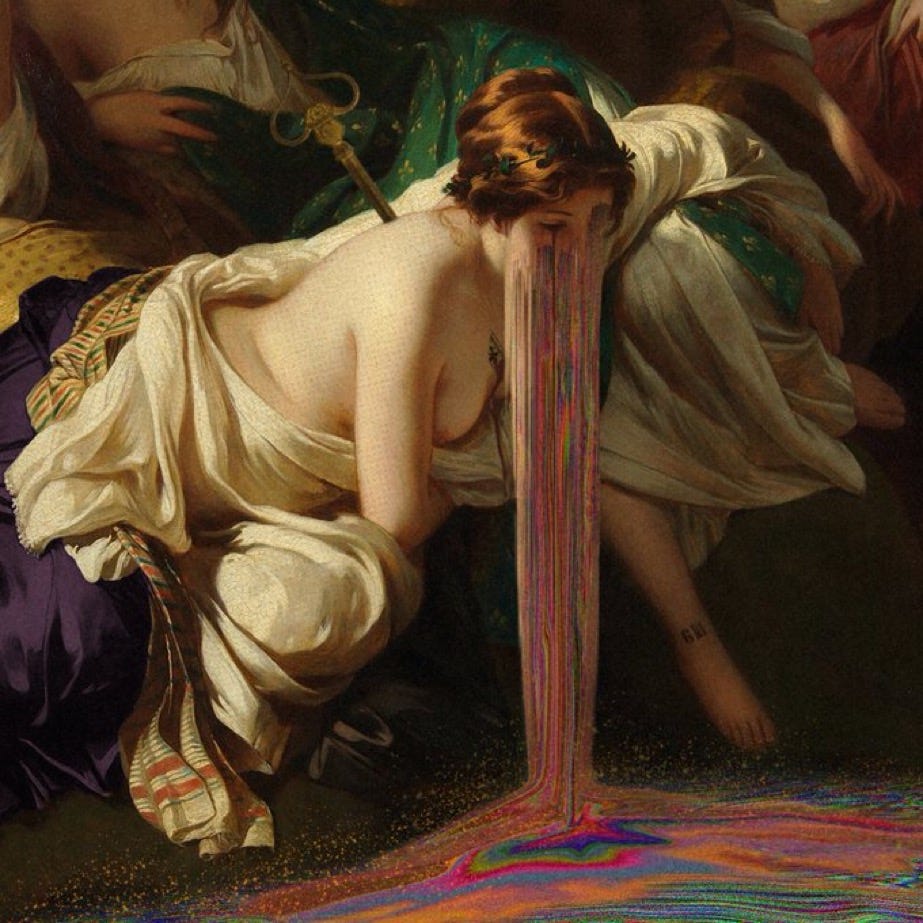
YOU LOOK DOWN AT YOUR PHONE.
IT’S A WALK SIGNAL.
BUT YOU DON’T WALK.
Across the crosswalk, that is. A Honda Civic hesitates at the intersection, a sneaker scuffs against the pavement as it passes you. But none of it registers: not the drivers, not the pedestrians, not the helpful little brightly-lit stick man telling you it’s safe to cross. You’re stuck.
All that matters is the clock on your screen. It’s been five, maybe six hours. That’s a whole part-time work shift at the CVS down the corner from you, maybe a little more if you count the unpaid break time. You’re dressed like a car crash, and your heart feels like an airbag never deployed. Six hours is more than enough to build a house of regret, brick by brick.
Maybe it means everything, maybe it means nothing … and that’s the hell of it. The thoughts bang around your head like shoes in a washing machine.
The sun sets like a sinking ship, orange and hazy on the horizon. It’s not immediately apparent to you if this is an entirely natural phenomenon or consequence of the exhaust fumes of a thousand idling cars bleeding into the atmosphere. Probably the fumes.
You turn to me. “Will they ever respond?” you ask with a sigh.
”How should I feel?”
But I shake my head. These are the wrong questions.
The question you should be asking is: how the hell did we get here?
And yet, you don’t ask yourself that.
Spoiler: you’re a sucker. So am I. So are most of us, truth be told; don’t feel too bad. And, like a gym membership you can’t cancel without three forms of ID and proof you’ve relocated to Guam, we keep signing ourselves up. It’s in our nature.
Of course, if you didn’t care, if you could shrug it all off, it wouldn’t be a situationship; the pain is proof of purchase. In a situationship — a romantic limbo, more than a hookup but less than a relationship, thriving on undefined boundaries — the one who cares less holds the nuclear codes to your heart.
VOICES FROM THE TRENCHES
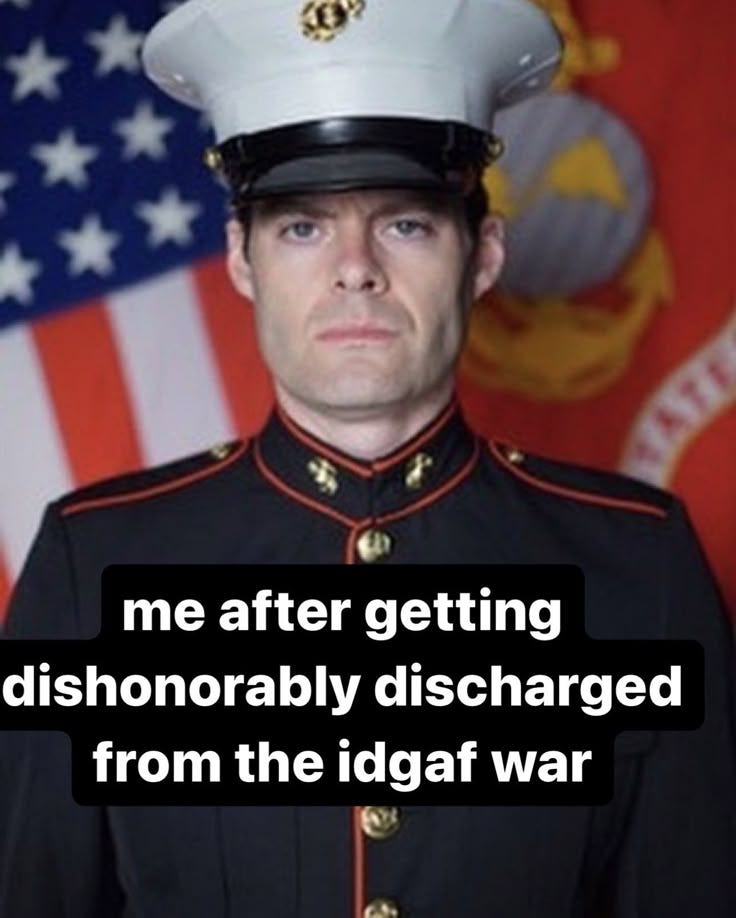
“Situationship.”
A word that tastes like diet commitment and smells like snake oil. Always talked about in the negative, yet perpetually reappearing, like emotional kudzu.
According to Wiktionary, it’s defined as:
“From situation + -ship or a blend of situational + relationship; A romantic or sexual relationship in which the parties do not consider or are not clear that they are in such relationship; such that is informal, without the responsibilities of a formal relationship; a companionship.”1
Fascinating. In plain English: a bear trap with your heart caught in it.
So, what do you do? Do you shoot, putting the poor animal out of its misery swiftly? Or do you simply let its life slip away, dying slow, afraid and in pain?
Logic says you shoot. But human beings are known to behave illogically; quite frequently, in fact. They will avert their eyes, shuffle their feet; mumble to themselves things like, “maybe it’ll wriggle free on its own” — anything and everything to abdicate responsibility, given the right time and the right place. We are creatures of comfort, after all.
There is perhaps a lot to be gleaned from the fact that many people seem to fall victim to situationship, and by extension, many people are choosing the second option.
Ending a situationship — calling a spade a spade, essentially — would be merciful. But mercy requires courage; courage is in short supply these days.
The result? A million mini-tragedies. Texts that shrink to single words, effort that seemingly drains out like a punctured tire. Potentially hundreds of hours, wasted.
From the outside, it’s maddening. You want to grab your friend by the shoulders and scream:
“YOU DESERVE BETTER THAN THIS! THIS IS A PYRAMID SCHEME, WITH KISSING!”
Of course, it’s so obvious to the outsider, to the étranger. But rarely, if ever, can the victim — dare I use that word — find the courage to stand up for themselves.
But they won’t. Maybe they can’t. They’re hypnotized by the narcotic drip-feed of attention.
That’s the terrible genius of the situationship: the cruelty is so small, so plausible-deniable, it almost feels rude to name it, like you’re some kind of romantic-paranoid-schizophrenic.
So, how did we get here?
Well, having had the dumb luck to have not been the victim of one (yet), but nevertheless psychotically compelled to write about it, I had to ask around.
So naturally I lobbed the question out there, like a flare out on the highway after a late-night car breakdown:
“Have you ever been the victim of a situationship? Can I interview you about it?”
A half-serious, half-suicidal inquiry in the name of “press freedom.” The kind of question that feels safe to ask through the glow of a screen at 11:56 PM, when only the sleepless reply, when you’ve had a couple, and when none of your friends take your journalistic pursuits particularly seriously. But, of course, simply writing about situationships had to not be all that easy, either.
The reply came back flat, surgical, and cold, just like a scalpel dropped from a chilly hospital tray.
“I’m sorry I can’t be more help but that isn’t really something I want to do.”
Bang. Metaphorical door slammed. No witnesses. Case closed.
The body registers rejection long before the brain can talk you down. One minute you’re a professional with a notebook, the next you’re a sad-eyed fool, doubled over, wondering if your whole career is just a series of people politely refusing to talk to you.
And, coincidentally, that’s usually what you feel like at the end of a situationship, too. Anticlimactic, empty, humiliating.
Love, sex, and now half-relationships — these are the radioactive materials of the 21st century — you can forget about plutonium.
But not everyone was so tight-lipped. In fact, some people I probably couldn’t have paid to stop complaining about their situationship. One confessed:
“I have participated in hookup culture, and I don’t see myself as a relationship person, and I enjoy sex. However, for other people, I think they do it because it’s like all you can get with a connection with people.”
Perhaps the concept of the situationship as less than a relationship is not so much the problem, but more the lack of a meaningful choice between the two. Romance (or just sex, if you prefer) is based on emotion. As intelligent as we have become, evolution still does not trust us to reproduce using our higher level thinking. And as a consequence, you cannot always expect humans to behave rationally in love (or whatever you care to call it at the given moment).
Another described the addictive rush:
“The high is always in the beginning. The long nights where everything feels charged. The texts that come at 2 a.m. and light you up. The laughter, the closeness, the illusion that you’ve stumbled into something profound without having to define it. But like every drug, the high doesn’t sustain. The comedown is inevitable, and the withdrawal is cruel.”
The perception of situationship, at least from where I’m standing, is resoundingly negative. Very few people, if anyone, had a positive word or phrase or spiel to speak about “situationships.”
Said another,
“depends on the age group. situationships my age tend to be because people dont want to tie themselves down and waste their ‘good years.’
its weird because they will tell you they are living the most optimal way but are super scared of their future.”
You can hold expectations, cast predictions, extend trust — but the other person does not always have to uphold them. In fact, oftentimes they will frequently not, and will do so without real consequences. A younger respondent framed it as fate:
“It is absolutely a real thing it’s just way more niche situation than you think.
I spent a few years working in central America, running a backpacker hostel and bartending, and had one whirlwind love affair for a couple years with a girl from NYC with some crazy high paying WFH [Work From Home] corpo job. I was a gorgeous, nobody Canadian boy tradie from the sticks. Our lives and legitimate love was never going to work outside this very constrained situation we were in, so we hung onto it for as long as we could until it had to all fall apart. Many would call this a situationship.”
With the lack of sound structure to hold up these expectations, the oft-dreaded situationship often rears its ugly head. Of course, there were dissenters:
“A situationship is not a real thing. It’s a phrase men invented to describe a woman who doesn’t want to date them but continues replying to their texts. I think zoomers refer to this as a ‘situationship’ where people basically act like they’re together but usually without any (or much) physical intimacy.”
It seems that in our attempts to try and rationalize our way out of emotion, we have, in many ways, made a much more confusing and complicated situation. We have begun to avoid paying the electricity bill by never turning on the light; but as a consequence, we stumble around the house, unsatisfied and blind. You trade one inconvenience for, arguably, a much worse other.
Others framed it as weaponized vagueness:
“[Situationships] thrive on vagueness which allows them to get all the attention with none of the accountability.”
They continued,
“I don’t end up in such situations [normally] but if one did start I would just say ‘that’s not appropriate’ and move on with my day. They only have as much power over you as you give them.”
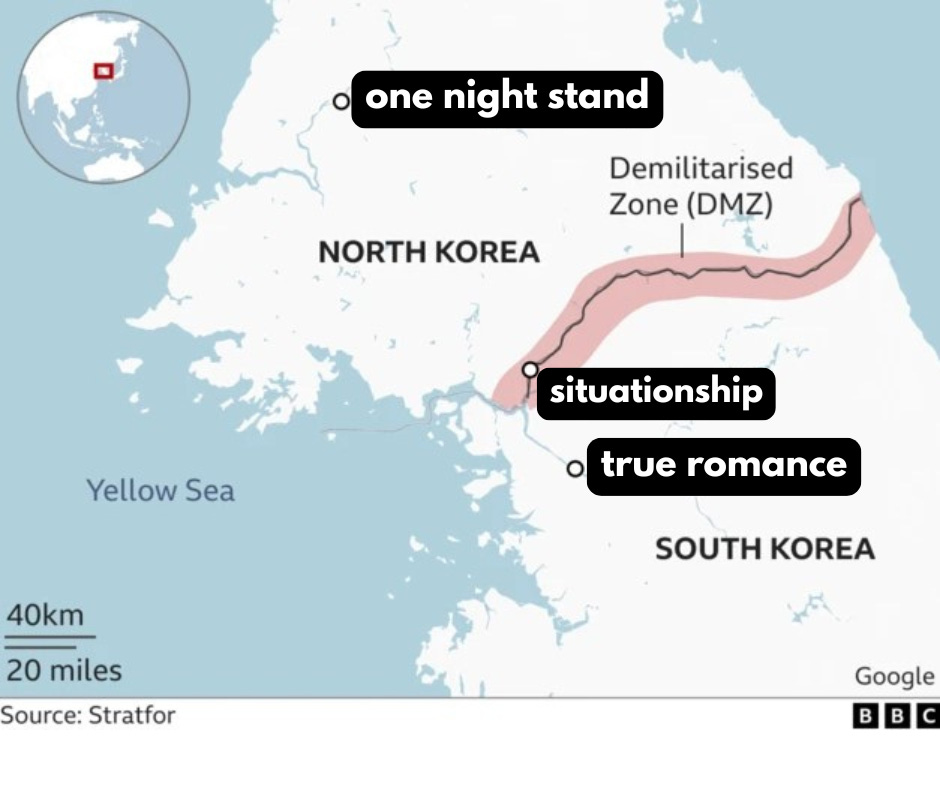
THE EMOTIONAL DEMILITARIZED ZONE
What do these quotes tell us about ourselves?
Well, the human animal has always been afraid of two things: being trapped, and being alone. The tension between those two opposites runs through every virtually every myth, every religion, every piece of bad poetry ever written, in some way. We want connection, but we simultaneously fear the burden it comes with, because it can incur a very high cost.
How do we reconcile this?
In earlier eras, social infrastructure like marriage helped handle the contradiction: you signed a contract, learned to live with the ‘chain,’ and were supported by your immediate surroundings. In 1960, 72% of U.S. adults were married; by 2024, that number dropped to less than 50%, per the U.S. Census Bureau.
We’re freer than ever, but that freedom comes with ambiguity.
Now the chains have been rusted through by 21st century capitalism and self-help rhetoric, or maybe progressivism, or maybe hedonism, or some other -ism, and we’ve built something new: the void. It kinda resembles freedom, but disappears between your fingers when you try to grab it. Much less pressure, much less responsibility, but also usually much less rewarding in the long-term.
Why is it more frequent now? Because, in many ways, modern life is engineered for it.
Algorithms feed us infinite options, infinite distraction, infinite maybes. Each meme or tweet or god-knows-what is as fleeting as the last. Our current mode of consumption, in many ways, keeps us permanently dissatisfied by feeding on such feelings. An psychological chocolate-chip cookie rather than a steak dinner. A situationship may be less of a bug than it is a feature of modern life. We are tiny idols at the feet of digital gods.
And yet, underneath it all, there is a deeper revelation: situationships thrive because they reflect our deeper human condition, a certain flawed ape-like quality looking for the greatest reward with the least risk. They’re a testament to still being human in the 21st century.
And now, we are all stuck in our own DMZs — political, spiritual, and more. A North and South Korea technically at peace, but with guns perpetually trained in the direction of the opposing side, should someone try to pull anything.
Yes, situationships can tell us more than just the status of modern romance; they’re the romantic expression of a wider civilizational stasis. Everything in our era feels suspended, whether it’s politics locked in endless culture wars, economies caught between boom and bust, climate action stuck at the bargaining table while the seas rise and cities sink. We live in a world of half-measures and deferred decisions, a culture allergic to commitment and effort. Of course our love lives would mirror that; what the fuck did you expect? The situationship isn’t an aberration — it’s the logical romantic form of an age that can’t pull the trigger on anything, from legislation to a text message.
No war, no peace. Just waiting.
Maybe that’s the real sickness. An autoimmune response to boundaries, obligations, following through; an age of unprecedented deconstructivism. Boundaries are treated like something akin to asbestos: dangerous, outdated, ripped out in the name of progress.
But is it really progress? Are we so enlightened?
Labels, definitions, commitments — all shoved into the garbage without a second thought. Oof. To live without demarcation is, broadly speaking, sold as living with freedom: no lines, no cages, no responsibility. It seems reasonable to conclude that we’ve mistaken impulse for philosophical sophistication, vagueness for liberation, detachment for maturity, etc., etc.
But maybe it’s closer to cowardice in drag. And, now, everywhere.
It’s quiet, yes, for now, but only because everyone’s waiting in silent anticipation for the next shell to drop.
And that, dear reader, is the truth of the situationship: the romantic DMZ of the idgaf war. Not dating, not single, not committed, not free, not enslaved. Both parties camped out on opposite sides of the border, sending out occasional flares of affection, testing the perimeter, never daring to plant a flag.
Ultimately — not very ideal.
The punchline: we’re told this, in theory, is liberation. That vagueness is modernity. That ambiguity is sexy.
But if that were true, why is everyone complaining?
This is The Great American Half-Relationship Experiment: a grotesque, unregulated trial being carried out on millions of unsuspecting citizens. No IRB approval, no informed consent necessary.
We are, at least from where I’m standing, an increasingly unhappy nation of guinea pigs running laps on the hamster wheel of “we’ll see where this goes;” the emotional version of buying timeshares in Florida swampland. There is maybe value to stuffy old order and routine yet.
But, there are, of course, “laws of the jungle” to help you survive such an ordeal.
The situationship is far older than you or I; it can be thought of as an ancient beast we have forgotten how to defend ourselves from, and as such, it holds significantly more power under modern conditions.
In my peer-reviewed, clinical research of the situationship, I can offer up with a few rules that may help you avoid the emotional potholes that are so common to modern dating. So, here’s what you can do to survive (maybe):
The one who cares less controls the clock. Don’t let them set the pace. What do you want?
If they can’t define it after three months, walk. You’re not the one.
If it looks like a duck and texts like a duck, it’s a duck. Stop indulging vague replies and ghosting; those are your exit signs.
They end in heartbreak. Hitting ‘eject’ now saves you a ton of time — and pain — down the line. Do I really have to explain this one?
And with that: greetings, and welcome to the new abnormal! Commitment without commitments, intimacy with an asterisk. It’s a brave new frontier with every kiss is a limited-time offer, every “we” is written in pencil. In short, grotesque parody of love.
And, like many American experiments of years past, it likely will run until the wheels fall off, the subjects riot, or somebody finally admits that the emperor has no clothes.
Hunter S. Thompson once said:
“We are all alone, born alone, die alone … we shall all someday look back on our lives and see that, in spite of our company, we were alone the whole way. I do not say lonely — at least, not all the time – but essentially, and finally, alone.”
I believe him. I’m not saying to not give people a chance … but I think if they deserve the chance, you will probably know it.
So if you’re in a situationship, try to remember:
Don’t settle for diet magic. Demand the real thing. Don’t swallow an aspartame romance and try to pass it off as sugar; your time is too valuable.
And, so, if you don’t feel the spell? Then what you’ve got is a cheap trick. And you’ll know it, when the rabbit stays in the hat.
Which brings us back to the crosswalk. The light says walk, but we don’t.
We stand there, phone in hand, watching the seconds bleed away, waiting for some cosmic revelation that will never come. The car idles. The air thickens with fumes, and we choke on them. But still, we hesitate. Maybe that’s what a situationship really is: not the wrong love, but the refusal to move, to risk, to cross.
The street isn’t going to cross itself. Neither will your heart.
Take a step.
https://en.wiktionary.org/wiki/situationship