


WHEN EVERYTHING IS RECORDED, EVERYTHING BECOMES A PERFORMANCE,
AND when it comes to performances, there is a concept that exists called “playing to the gallery.” Typically when people refer to the phrase, they mean it in a strictly poetic sense. They mean that you shouldn’t create art you think other people will like, but that you should create art that you like and the suitable audience will follow, more or less.
I guess I’m using it a little more liberally here. No longer limited to the artists and musicians of the world, the idea of “the gallery” seems to have grown and contorted to encompass our entire lives. What did we expect? Technology has enabled us to make our lives one big performance. We curate vacation photos, edit our selfies, post videos of all the concerts we go to, stack our LinkedIn profile with bullshit accomplishments, blah blah blah, all in the effort to make it seem as if we are living the dream. Rarely, if ever, though, are we living the dream.
The concept of a “performative life” is far from a novel idea; in the 20th century, French philosopher Michel Foucault wrote about methods of social surveillance and their influences on human behavior in his book Discipline and Punish, and others had played the idea even before him.
However, the social surveillance Foucault described in 1975 - essentially, the ways society and institutions indirectly force us into following certain behaviors and norms - is not exactly the same as what we see today. The performance has taken on a new, more dominating dimension.
In his book, Foucault drew on the idea of a “panopticon,” the name of a conceptual prison design from the 18th century by Englishman Jeremy Bentham. In Bentham’s own words,
“The Building circular – an iron cage, glazed – a glass lantern about the size of Ranelagh – The Prisoners in their Cells, occupying the Circumference – The Officers, the Centre. By Blinds, and other contrivances, the Inspectors concealed from the observation of the Prisoners: hence the sentiment of a sort of invisible omnipresence. – The whole circuit reviewable with little, or, if necessary, without any, change of place.”
Bentham’s prison design was ingenious in that was structured to be functionally all-seeing. The way he envisioned it, guards could monitor all prisoners at all times; of course, for practical reasons, the guards couldn’t watch all prisoners at all times, but the prisoners would never know when the guards were or weren’t watching them. Such a design, at least in theory, would keep the prisoners on their best behavior at every hour of the day, unless they wanted to risk punishment.
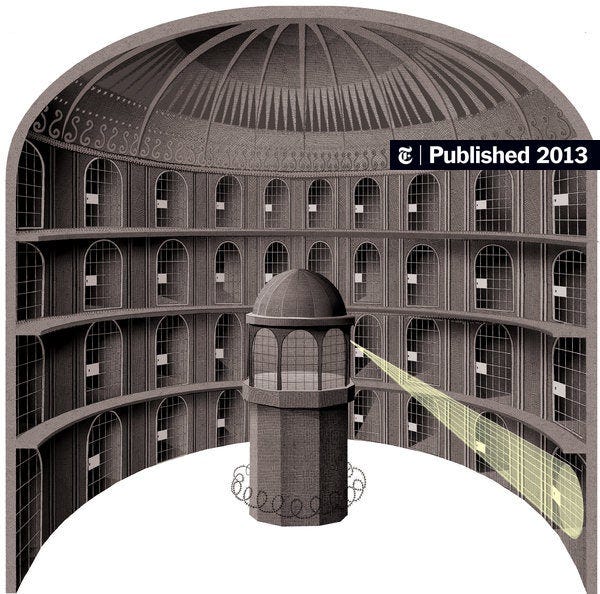
Foucault leveraged this design as a metaphor for society and power. He believed that social structures and institutions acted like the panopticon’s watchtower, motivating people to follow social guidelines and norms - to “act normal” - as we never know who might be watching. Through this structure, we become prisoners, self-policing and conforming to society’s rules, subservient to institutional power. And we do it without anyone even having to tell us so, out of fear that should we deviate from our act and have the bad luck of being spotted by a guard, he will proceed to give us a good beating while all the other prisoners watch.
Building on his metaphor of the panopticon, we have seen in modern times a beautiful marriage between the indirect dynamics of power Foucault described (social rules and structures) and direct power (surveillance cameras, online tracking, etc.) in modern life.
Technology has enabled randoms online to reinforce social etiquette from thousands of miles away, provoke waves of online harassment against a given target, make private information public, and maintain records of every perceived indiscretion like it’s a felon’s rap sheet - “the internet is forever.” Even with CCTV cameras on every corner, in the event there isn’t one, a person can whip out their phone and blast whatever scene they happen to capture to whoever happens to have nothing better to do than watch it.
People raised in the 21st century are acutely aware that in the modern age we are probably being watched, recorded, and monitored at any given moment, even if we don’t know exactly how or why. We even do it to ourselves - remember Snapmaps?
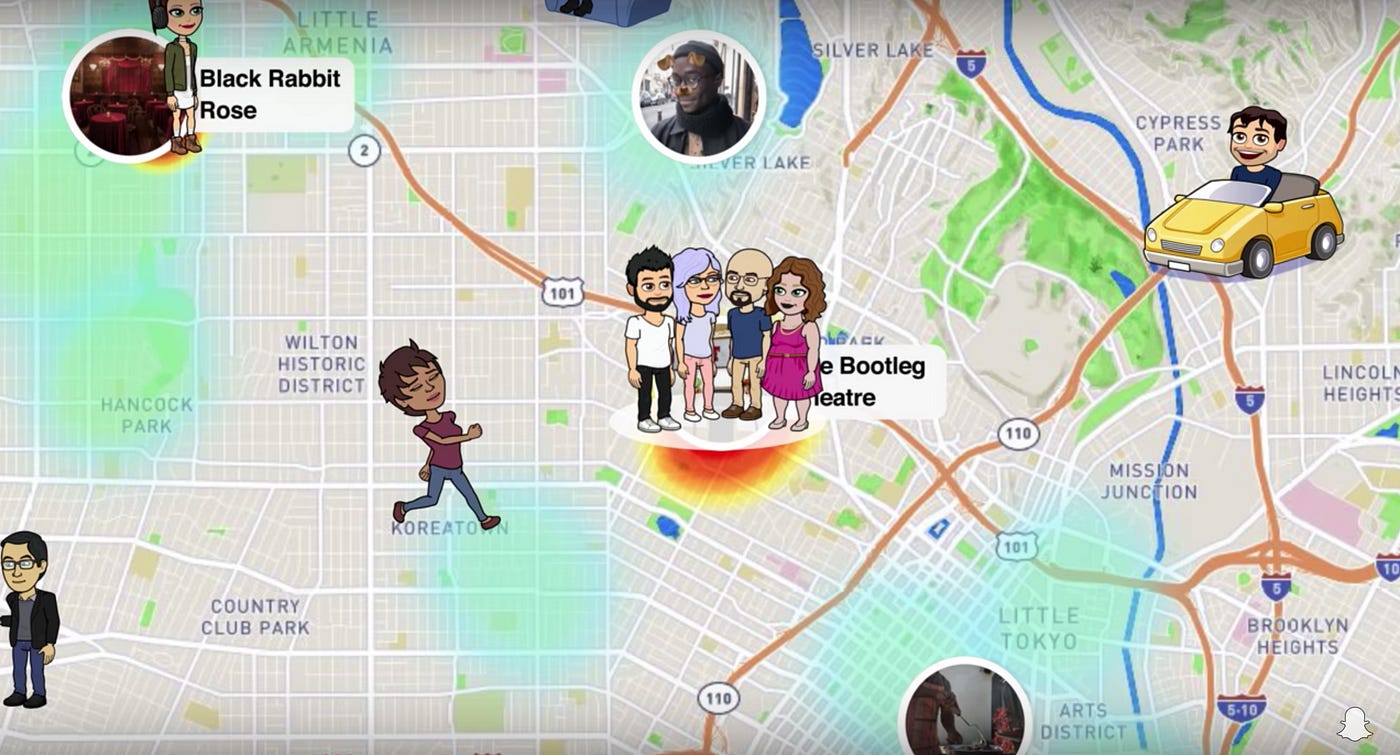
(And you better believe people like the NSA and FBI are holding onto those receipts, too.)
In more recent years, dozens upon dozens of books, think pieces, movies, etc. have scrutinized aspects of the surveillance society, in a variety of different ways. I won’t rehash all that here.
I’m just trying to plot a prison break.
An easy example of how we play to the gallery, and how we can stop, is to start with is how common disclaimers are now. For better or for worse, disclaimers and warnings have become an accepted part of modern American society. The widespread use of disclaimers likely owes its origins to the legal battlegrounds of the 20th century, with waves of negligence lawsuits (both of a frivolous and legitimate nature) reinforcing the idea that companies have a responsibility to help consumers use their products safely.
Naturally, companies really like their money, and so they devised a method to keep it: warn consumers of almost any adverse effect that could occur by using a product incorrectly, and pre-empt any future hypothetical lawsuits. Often, this ventures into the absurd - think of things like the warnings on your space heater reminding you not to drop it in the bathtub, or the “CAUTION: Contents may be hot” message printed on the side of your coffee cup.
Well, yes, I sure hope the coffee is hot - that’s why I ordered it.
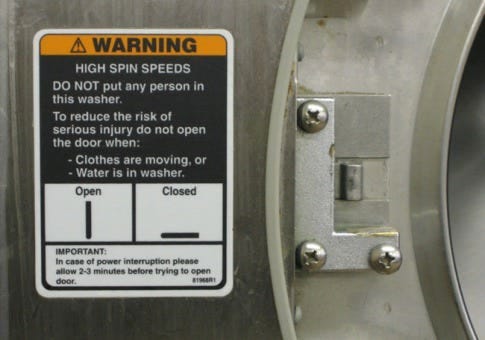
This trend has had downstream effects on society at large, to the point where you likely encounter dozens of disclaimers daily, both legal and colloquial.
You might have seen it on places like TikTok where, instead of being used by a billion-dollar corporation, the layman has now turned to using (sometimes rather dubiously) these disclaimers, maybe in the form of warnings like “This is not financial advice!!!!11!!” to preface their video on why you should invest in the next big meme stock. However, I would probably argue that if you take your investment advice from TikTok and end up losing big, disclaimer or no disclaimer, you probably deserve it.
Regardless of whether they’re done out of fear of legal consequences or simply to pre-empt any negative social reaction, they’re still done out of fear - and people seem to use them a lot. Disclaimers have slowly creeped into any and every facet of modern life as a method to mitigate any potential responsibility or blame.
One of my favorite comedians, Noel Miller, is a case study in this phenomenon. Miller’s comedic style could be described in a number of different ways: dark, unhinged, maybe even “edgy.”
But as much as I love Miller, I’m not a fan of his overuse of disclaimers in his bits and his videos. Miller has a recurring bad habit in his videos where he prefaces or follows every politically sensitive joke with something along the lines of “remember, this is satire” or “we’re just joking, folks.” Even after many years of doing shows and podcasts, he still seems to be a victim of playing to the gallery.
I find this type of disclaimer annoying for several reasons:
Explaining a joke (or explaining that a joke is a joke) almost always kills the momentum of whatever you’re doing.
The “please don’t strike my video, YouTube overlords!”-style bit can be done tastefully, but just like any joke, it gets old after a couple times.
Adding a disclaimer anytime you talk about something potentially politically sensitive weakens the joke. It makes it seem like you’re bailing on the bit; stand behind it!
There’s nothing wrong with doing this type of thing occasionally, and plenty of comics have. But once you start to do it all the time, it makes you - and your jokes - look weak. Are you afraid of your audience? Do you think that they’re not sure if you, a professional comedian, are joking?
It doesn’t make sense. So, why then, does he choose to do this? And, maybe more importantly, why the fuck have I bothered making this detour to some random YouTuber in an article about surveillance?
I’m not inside Miller’s head, but if I had to guess, it’s because Miller is acutely aware of the panopticon. Besides hosting his regular comedy podcast, he also has a solo project called “The Company Lot.” On “The Company Lot” podcast, Miller, who was a software engineer prior to his comedy career taking off, frequently discusses aspects of “surveillance capitalism” and ponders the question of whether we’re headed towards a Big Tech dystopia, infused with the comedic elements he’s known for. He’s even referred to the book “The Age of Surveillance Capitalism,” by Shoshana Zuboff, as his personal “bible.”
Miller knows that he’s being tracked all day every day, especially as a celebrity. He’s not exactly A-list, but he is still at a level where much of his personal life is also his commercial life.
All it takes is one clip out of context and the next thing you know, his tour dates are canceled, his advertisers drop like flies, and other influencers stop collaborating and messaging with him. That all is to say, the modern use of disclaimers like Miller’s is one born out of fear. He wants to make it abundantly clear what his positions are, even to the lowest common denominator. That said, I understand why Miller does it - in fact, I don’t blame him at all - but I can’t support it.
Me? I refuse to live a fearful life. I’m not gonna censor myself or add fifty disclaimers in the event some viewer can’t parse what I’m saying. Parse this: suck my balls.
Anytime you censor yourself, you are playing to the gallery. What does it mean to play to the gallery? It means being the someone someone else wants you to be, or, in other words, to be inauthentic. Being inauthentic, even to yourself, is dishonest. I really hate dishonesty.
Of course, it’s easy to say “stop censoring yourself;” it’s another thing to do it.
Most people who censor themselves like Miller aren’t doing it because they enjoy it; they are doing it because they are aware of the very real consequences that can stem from saying the wrong thing at the wrong time, and having the wrong person hear it. This has been amplified to the nth degree via the online space.
Even I am guilty of “playing to the gallery” sometimes, though I try very hard not to. On here, I scan lines and revise them if I think that, in malicious hands, they could be taken uncharitably and used against me somehow. I water down points, claims, and explanations to make them as expressly clear as possible as to what my intentions are lest someone tries to manipulate and stretch my words like putty to serve an agenda. I have avoided topics that I have wanted to write about because I fear I will be misunderstood or disparaged; not on the merits of anything I would actually write or think, but because of what people will imagine I am writing or thinking based on their preconceived notions. Labels hold power. And once you have one, they can be very hard to get rid of. Evolutionarily, humans have become very sensitive to judgement lest they fuck up and get kicked out of the tribe; it’s natural, then, that there is so much paranoia and fear in our society today if literally anything you do or say holds potential for ridicule and shame permanently and worldwide.
There’s nothing wrong with writing like this in principle; in my opinion, writing is generally best when the writer writes for clarity. However, it doesn’t strike me as healthy to be constantly paranoid about whether everything you say or do will be taken out of context and blasted across the internet, disparaged for claims you never made, or suffer damaged relationships because someone jumps to conclusions, or maybe afraid you’ll get fired from your job because Edna in HR doesn’t even know what “satire” means; yet, many people seem to be.
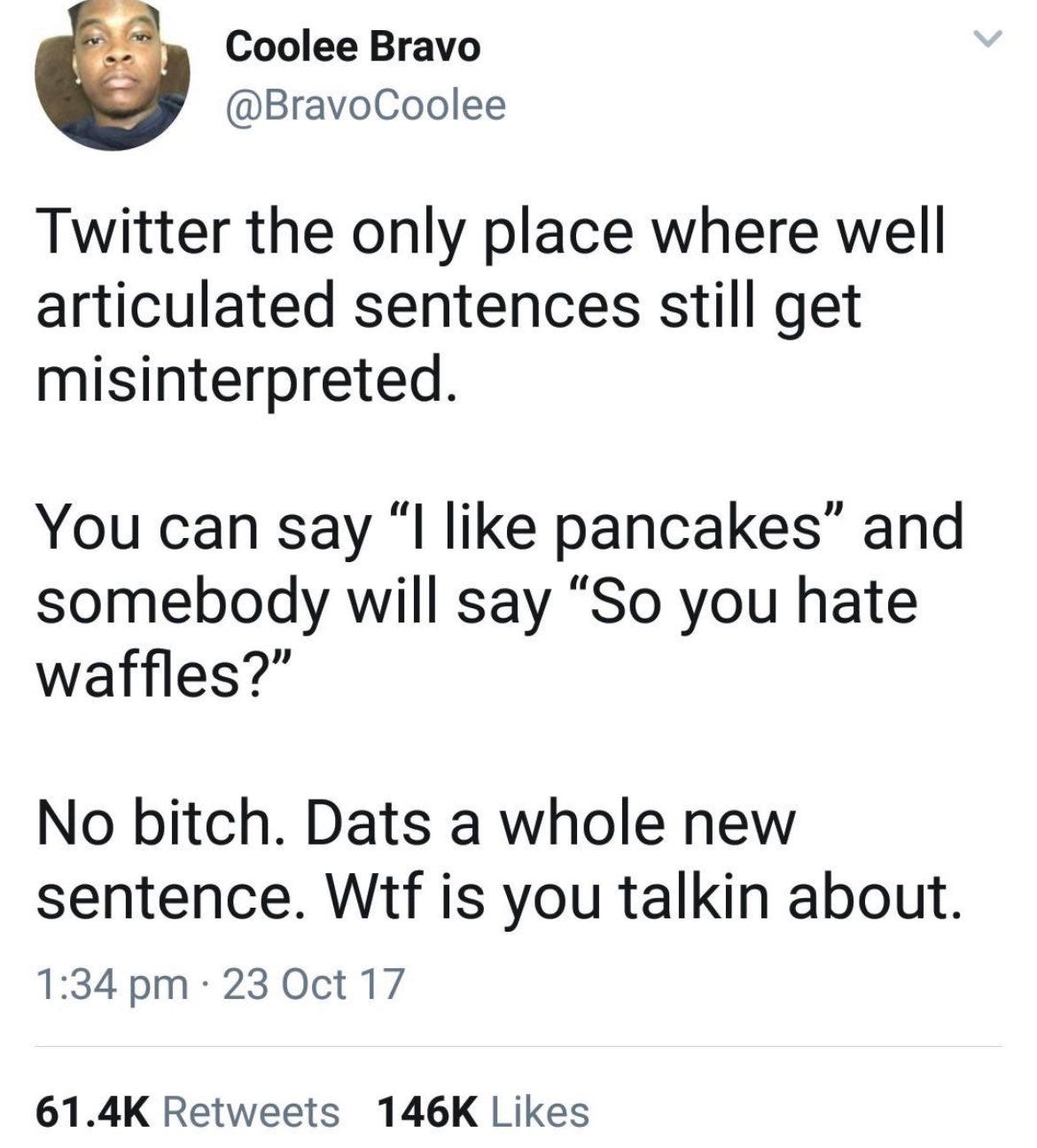
The solution? Stop giving a fuck. Tear down the watchtower in your head.
If people misunderstand you, that’s not your problem - not really. Not everyone needs to understand you. If they’re genuinely interested in understanding what you were trying to say, have a dialogue and attempt to explain in a way they might comprehend better; who knows, you might make a new friend from it. But if they’re only interesting in dunking on you to generate likes and their own ego, or if they clearly ignore all the cues you’ve given as to your intentions with something, ignore them. At the end of the day, you cannot control what other people think or say, especially if they have a motive to make you look stupid. As for the job stuff, maybe don’t put those tweets about buttchugging the keg on your public Twitter profile.
I refuse to create a SparkNotes™ version of myself. I refuse to censor myself or slap a warning label across my metaphysical forehead. You either get it, or you don’t. It’s cool either way.
Do yourself a favor. Release yourself from the mental labor of constantly self-censoring and just be who you are. And once you do it, it will empower other people to do it, too. This doesn’t mean to speak without a filter and say anything that comes to mind - a little decorum, please - but don’t live in fear. The world could probably benefit from a few more people brave enough to speak their mind.