

How One Biotech Company Gave Thousands HIV
A violation of "basic principles of medical and business ethics."

INTRODUCTION
The emergence of the AIDS epidemic in the early 1980s posed an unprecedented challenge to medical science and public health, particularly for individuals with hemophilia who relied on blood-derived clotting factor to manage their condition.
Documents from the period reveal that Cutter Laboratories, a subsidiary of Bayer AG, became aware by 1983 that its Factor VIII and IX concentrates, critical medicines in treating hemophilia, were contaminated with the human immunodeficiency virus (HIV), but continued to sell the product anyway.
Despite their knowledge, in the face of substantial financial losses, Cutter elected to distribute these contaminated products to international markets, particularly in Asia and Latin America, between 1984 and 1985. This decision, made in regions with less stringent regulatory oversight, contributed to the infection of thousands of hemophiliacs with HIV, exacerbating the global toll of the AIDS crisis.
EARLY HISTORY: 1971-1981
During the initial stages of the AIDS epidemic, though the disease had not yet been discovered at the time, the effects of what is now known as HIV were observable. In the late ‘70s and early ‘80s, doctors were puzzled by the increasing number of deaths in their otherwise healthy patients. These patients were experiencing a steep decline in immune function, and were succumbing to what are known as “opportunistic infections,” or otherwise mild bugs that only pose a threat to individuals with severely weakened immune systems. At the time, scientists were at a loss to explain why so many people’s immune systems were suddenly and inexplicably failing across the United States.
This pattern eventually became known colloquially as “4H disease” among US researchers, an abbreviation for the four populations where it was showing up the most: heroin users, Haitian immigrants, homosexuals, and hemophiliacs.1 The Centers for Disease Control (CDC) would eventually coin the official term “Acquired Immuno-Deficiency Syndrome” to describe the phenomenon later in 1982, but it wasn’t until 1985 that HIV would be definitely identified as the cause of AIDS.
But even prior to 1985, though experts did not know fully know what disease or diseases were causing AIDS, they knew full well what populations it affected the most and how it was spread - almost exclusively through sexual contact and bloodborne-transmission. In fact, as early as 1982, the Centers for Disease Control had warned that “that hemophiliacs were becoming ill from blood products” and acquiring AIDS, though the specific cause was, once again, unknown.2 They reiterated this point again in March 1983, saying more explicitly that clotting factors “appear responsible for AIDS among hemophilia patients.”3
Hemophilia, for those unfamiliar, is a genetic disease where the body doesn’t produce enough clotting factors - or, the proteins that help blood form scabs and stop bleeding. As a result, people with untreated hemophilia bleed more easily and for longer periods, leading to dangerous blood loss and occasionally even death.
The modern treatment for this is pretty straightforward: more clotting factor. Though we are now able to synthesize these clotting factors in a lab, for a long time, the standard treatment for hemophilia was with blood transfusions. These transfusions contained the necessary clotting factors taken from non-hemophilic individuals. But these transfusions were “pooled and isolated from thousands of anonymous and untested blood donations” during the time of the AIDS crisis, including from high-risk sources like US prisons or underdeveloped countries.4
One of many companies that produced these types of clotting factor products was Bayer AG.
BLOOD MONEY
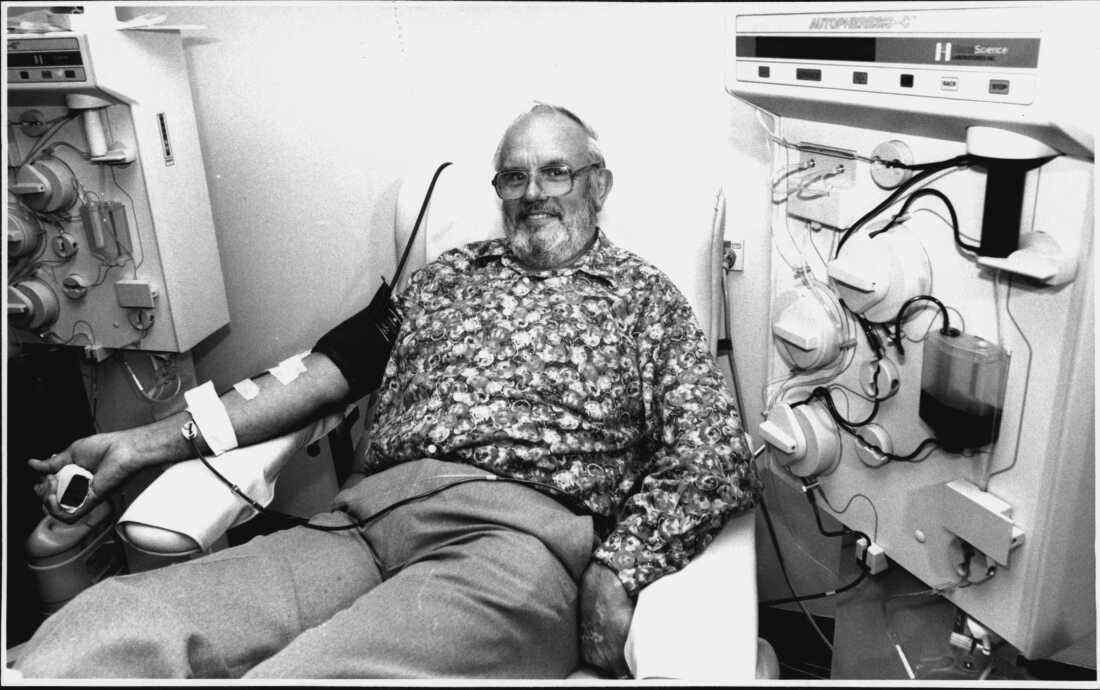
With the rise of HIV, using plasma from human donors to treat hemophilia introduced previously unknown risks to patients. Bayer was well aware of this, which is why it introduced a safer version of the medicine in February 1984.5
"There is strong evidence to suggest that AIDS is passed on to other people through ... plasma products,” read one internal Bayer memo from 1983.6
By 1983, other companies in the industry had begun to heat-treat their blood to render the bacteria and viruses in blood products inert, a process not unlike how a fever fights infections in the human body; Bayer was one of the last companies to receive US approval for its new heat-treated clotting factor in early 1984. But, when the French government made the decision in 1983 to halt all imports of foreign clotting factor, Bayer’s Cutter responded rather strangely. Contrary to its internal position and upcoming new product, Cutter responded to the decision by stating,
“AIDS has become the center of irrational response in many countries…this is of particular concern to us because of unsubstantiated speculations that this syndrome may be transmitted by certain blood products.”
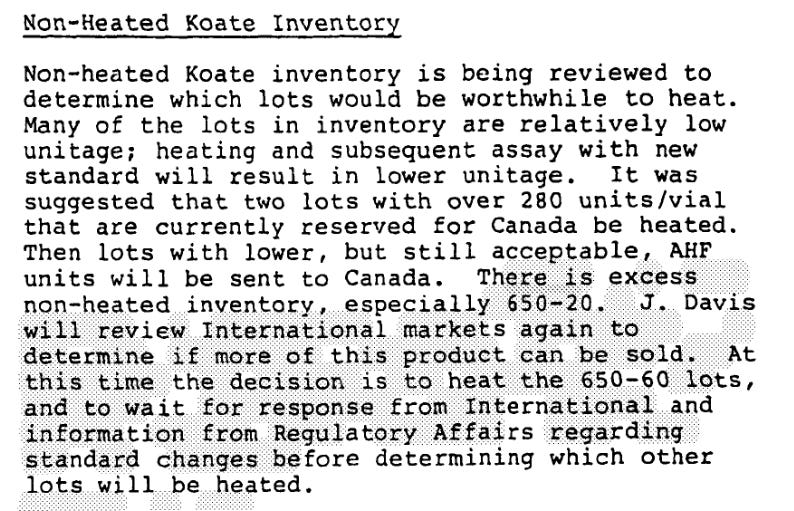
While manufacture of the new product began in early 1984, Bayer continued to manufacture the old product alongside it until August 1984, a decision believed to be based on the fact that the older product was cheaper to produce. Notes from a Cutter company meeting in mid-1984 noted that, while the new product was selling well, “there is excess nonheated inventory,” and that the company needed to “review international markets again to determine if more of this product can be sold."
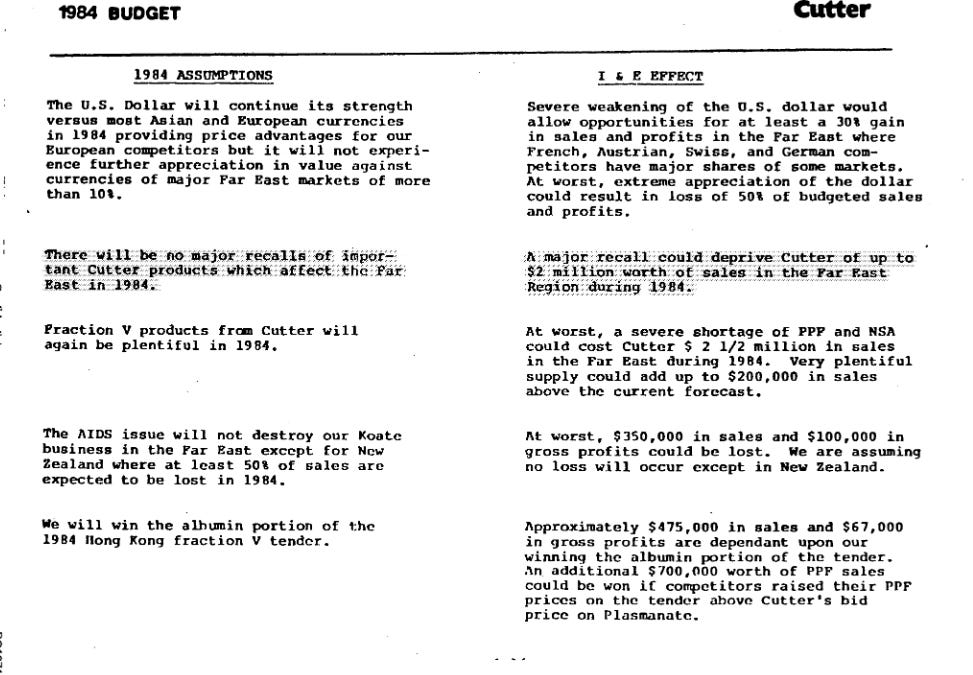
Cutter estimated that it risked losing $2 million in sales if it were to pull the old product off the shelves in a recall. Records indicate that in one case, Cutter asked a Hong-Kong distributor to “use up stocks” of the old clotting factor before they could receive its “safer, better” product. By 1985, once it was becoming apparent that new HIV infections in Hong Kong were directly linked to stores of Cutter’s old clotting factor, Cutter’s Hong Kong distributors demanded the newer product; Cutter told the distributor flatly that the new medicine would mostly be going to the US and Europe and that Hong Kong wouldn’t be getting any.
By mid-1985, a Cutter executive noted that “It appears there are no longer any markets in the Far East where we can expect to sell substantial quantities of nonheat-treated [medicine],” and the company stopped selling the older product soon after.
The consequences of this 2-million-dollar decision were catastrophic. By 1992, at least 10,000 hemophiliacs internationally were believed to have been infected with HIV unknowingly from use of the clotting factor, and of those, approximately 2,000 died after developing complications related to AIDS.7 According to experts, coming to reliable figures on how many others these people went on to infect is “impossible.”8
"These are the most incriminating internal pharmaceutical industry documents I have ever seen," said Dr Sidney Wolfe in 2003, who, at the time, was director of the Public Citizen Health Research Group, an organization dedicated to transparency in medicine and “has been investigating industry practices for 30 years.” Another report described the incident as a violation “of basic principles of medical and business ethics.”9
At the time, though, the situation largely remained unknown to the general public. According to the New York Times,
“In May of 1985, believing that the companies had broken a voluntary agreement to withdraw the old medicine from the market, the Food and Drug Administration's regulator of blood products, Dr. Harry M. Meyer Jr., summoned officials of the companies to a meeting and ordered them to comply. ''It was unacceptable for them to ship that material overseas,'' he said later in legal papers.”
But Meyers also wanted the issue “quietly solved without alerting the Congress, the medical community and the public,” the Times continued, according to witnesses at the meeting. And so it was not until the late 1990s that the true scope of the problem became fully apparent.
CONCLUSION
By the end of the 1980s, it was estimated that a staggering 90% of hemophiliacs in the United States had been infected with HIV or Hepatitis C, a similarly transmitted disease, and 20% of hemophiliac deaths during the decade were due to AIDS, larger than any other cause.1011 One pediatrician, in a 2016 retrospective on the AIDS crisis, stated that “virtually every hemophiliac I treated in the mid-1980s has since died from AIDS.”12
One case, brought against Bayer and Cutter Biological in 2000, described a man named Kenneth Dixon, born with hemophilia in 1967. He was first given clotting factor to treat the condition in 1976, at nine years old. In November 1985, with testing now available to detect HIV, Dixon’s hematologist told him that an earlier sample of his blood had tested positive for the disease; his doctor’s opinion was that the source of the infection was probably untreated clotting factor, and that he would, in all likelihood, go on to develop AIDS. Dixon was only 18 years old.
Ten years later, in 1995, despite utilizing the treatments available for HIV at the time, Dixon died at the age of 28 from AIDS-related complications.
The case concluded when a jury found “Bayer and Alpha [a Bayer affiliate] liable for the negligent manufacture of an unreasonably dangerous product, and fraud, all of which were the cause-in-fact of Ken's death as a result of AIDS,” and awarded $35.3 million in wrongful death damages to Dixon’s family in a class-action lawsuit.13
And Dixon is far from the only one. In total, Bayer and three other companies affiliated with producing the product have paid a total of over $600 million in damages, or approximately $1.05 billion today, adjusted for inflation.
Bayer has insisted that it has always “behaved responsibly, ethically and humanely" in its operations.
Cohen, Jon. “Making Headway Under Hellacious Circumstances.” Science 313, no. 5786 (2003): 470b. https://www.science.org/doi/10.1126/science.313.5786.470b.
Bogdanich, Walt, and Eric Koli. “2 Paths of Bayer Drug in 80’s: Riskier One Steered Overseas.” New York Times, May 22, 2003. https://www.nytimes.com/2003/05/22/business/2-paths-of-bayer-drug-in-80-s-riskier-one-steered-overseas.html.
Bogdanich and Koli, “2 Paths of Bayer Drug in 80's: Riskier One Steered Overseas.”
PBS NewsHour. “Remembering Ryan White, the Teen Who Fought Against the Stigma of AIDS.” PBS NewsHour, August 11, 2016. https://www.pbs.org/newshour/health/remembering-ryan-white-the-teen-who-fought-against-the-stigma-of-aids
“Bayer Kept Selling Drug That Helped Spread HIV.” Sydney Morning Herald, May 23, 2003. https://www.smh.com.au/world/bayer-kept-selling-drug-that-helped-spread-hiv-20030523-gdgt3i.html.
Bogdanich and Koli, “2 Paths of Bayer Drug in 80's: Riskier One Steered Overseas.”
Josefson D. Haemophilia patients launch action against Bayer over contaminated blood products. BMJ. 2003 Jun 14;326(7402):1286. doi: 10.1136/bmj.326.7402.1286-g. PMID: 12805147; PMCID: PMC1151015.
Sydney Morning Herald, “Bayer Kept Selling Drug That Helped Spread HIV.”
McHenry L, Khoshnood M. Blood money: Bayer's inventory of HIV-contaminated blood products and third world hemophiliacs. Account Res. 2014;21(6):389-400. doi: 10.1080/08989621.2014.882780. PMID: 24785997.
Kelley & Associates. “AIDS: Lest We Forget.” Kelley & Associates, December 1, 2017. https://www.kelleycom.com/aids-less-we-forge/.
Hemorrhagic sequelae of immune thrombocytopenic purpura (ITP) in HIV-infected haemophiliacs - Scientific Figure on ResearchGate. Available from: https://www.researchgate.net/figure/Causes-of-Death-in-Hemophiliacs-1978-to-mid-1989_tbl2_20844912 [accessed 4 Jul 2025]
PBS NewsHour, “Remembering Ryan White, the Teen Who Fought Against the Stigma of AIDS.”
SMITH v. CUTTER BIOLOGICAL, No. 97-1468 (La. Ct. App. 2000). https://caselaw.findlaw.com/court/la-court-of-appeal/1100142.html.