


Introduction
There are moments in history when the past, like a half-drunken phantom, rears its ugly head and reminds us of the chaos we try so desperately to forget. Johann Breyer’s life is one of those moments - an absurd, grotesque spectacle of bureaucracy, terrible war crimes, and the twisted logic of American immigration law. Johann, who arrived in the U.S. in 1952 under refugee status, was granted a second chance at life, but perhaps what he didn’t bargain for was the inevitable unraveling of the lies he had buried for decades. Breyer wasn’t just another poor soul fleeing the war; this was a man who once stood guard at Auschwitz, ready to shoot anyone who dared to escape their death prematurely. Yet, in the Land of the Free, he was welcomed with open arms, into the City of Brotherly Love, his past a dirty little secret too well hidden for too long. It wasn’t until forty years later, when the gears of the justice machine finally began turning, that his dark history came crashing down on him.
“Onward Into Countless Battles”
Johann Breyer’s story was common enough. Breyer was a Czechoslovak national who immigrated to the US in 1952 to achieve a better life - by way of the 1948 Displaced Persons Act (DPA), one of many pieces of legislation enacted in the chaotic aftermath of World War II that permitted the admission of displaced persons in Europe to the US, given that they met certain guidelines. Through the DPA, nearly 200,000 refugees were resettled in the US by the cutoff date of June 30, 1952. “Approximately one million of [displaced] individuals either refused or were unable to return to their homes due to the presence of Soviet forces in Eastern Europe and the scale of destruction,” according to lawyer Michael M. Pavlovich.1 Specifically excluded from the act were any individuals who had assisted Nazi forces or who had participated in religious, ethnic, or racial persecution.2 Despite this, Breyer, who had in fact been a guard at the notorious Buchenwald and Auschwitz concentration camps, was granted entry to the United States in May 1952 as a refugee.
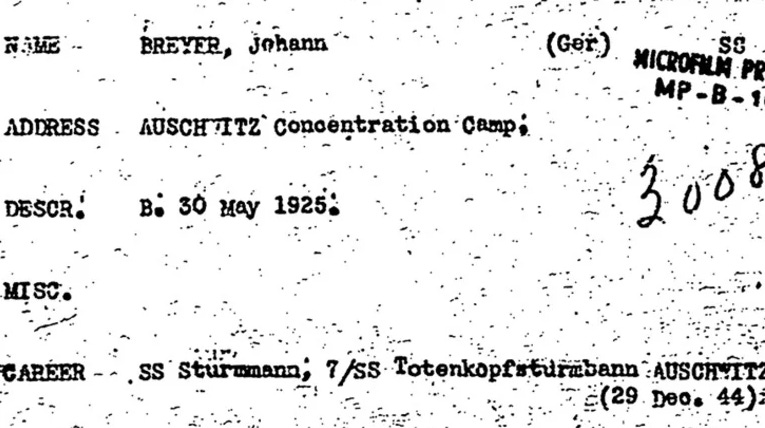
Breyer was born in what is now Nová Lesná, Slovakia, a town that was historically known as a mostly ethnically-German farming village, in 1925. At the age of 17, Breyer volunteered to enlist in the Waffen SS, the military wing of the Schutzstaffel, Nazi Germany’s premier security agency. He became a full member on February 10, 1943, and was subsequently assigned to the SS Totenkopfsturmbann ("Death's Head" Battalion), a subdivision of the SS. The main responsibility of this unit during the war was to guard concentration and death camps throughout Europe, including such infamous sites like Auschwitz, Dachau, and Treblinka.
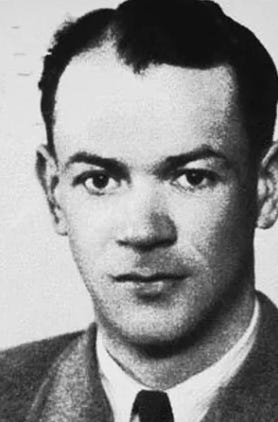
Breyer’s first post was as an armed guard watching over the perimeter of the Buchenwald concentration camp in Germany, where he served from February 1943 to May 1944, before being transferred to the Auschwitz death camp in Poland where he served from May to August of 1944. His main responsibilities at the camps were to " ‘[accompany] prisoners to and from work sites’ and to stand ‘guard with a loaded rifle at the perimeter of the camp with orders to shoot any prisoner who tried to escape.’ "3
By May 1945, the Third Reich had collapsed and Breyer was taken prisoner by the encroaching Red Army. Eventually, Breyer was freed and attempted to emigrate to the United States under the 1948 DPA; in his application, he asserted that he been a member of the German military, but did not identify his service with the Waffen SS.4
After arriving in the US, Breyer settled in Philadelphia, the same place his mother had been born, where he eventually married and raised three children, coming to work as a tool and die maker for an local engineering company, where he worked for 32 years. His neighbors came to know him as “Hans,” a friendly and affable émigré, never earning so much as a traffic ticket.5 Five years after his visa was granted, in 1957, Breyer petitioned to be made a permanent US citizen, a request that was granted by US courts.
It wasn’t until 40 years after his immigration to the United States that US immigration officials discovered who Breyer really was. During a routine cross-check between US immigration records and historical Auschwitz personnel records, officials finally realized that the same Breyer who had guarded Auschwitz had immigrated to the United States. The US Department of Justice’s Office of Special Investigations (OSI), a entity created in 1979 and specifically tasked with apprehending Nazi war criminals living in the United States, subsequently filed a petition for his denaturalization in 1992. Using their combination of historical analysis and detective work, the OSI had come to realize that Breyer had been a death camp guard during the war, not a simple refugee, and as such, alleged that he had “illegally procured” his citizenship under the 1948 Displaced Persons Act - the jig was up. Or so the Department of Justice thought.
As it turns out, Breyer’s case was anything but straightforward; rather, the case became the legal equivalent of a Gordian Knot, with court battles enduring for over a decade until their conclusion in 2003.
In response to the OSI petition, Breyer brought forth several convoluted - but important - constitutional issues at stake: first, Breyer argued that beside becoming naturalized through the DPA, he was also entitled to US citizenship owing to the fact that his mother had been born in the United States. At the time Breyer was born, settled constitutional law recognized that US citizenship was bestowed at birth upon all people born within the boundaries of the United States, the legal concept known as jus soli - however, outside of its borders, the government only recognized children of US citizen fathers as citizens, but not mothers. This doctrine was later overturned, owing to the passage of new legislation that included mothers, and not just fathers, as capable of bestowing citizenship in 1934 and 1994; however, the retroactive amendments of 1994 made explicit exceptions for children born to American mothers who had participated in Nazi war crimes during the Second World War. Breyer argued that these amendments were invalid under US anti-discrimination laws passed in the later part of the 20th century that outlawed discrimination on the basis of sex differences - including the conferring of blood citizenship solely from fathers.
To the Third Circuit Court of Appeals, Breyer’s point was a valid one. In its ruling, after Breyer proved that his mother had been born in the Manayunk section of Philadelphia, it stated that the government’s distinction in not conferring citizenship to children specifically because they were children of a female citizen (regardless of the actions of that child following birth), and not a male citizen, was unlawful, gender-based discrimination, and that the decision to revoke Breyer’s citizenship was an unconstitutional violation of Katharina Breyer’s equal protection rights - Johann Breyer’s mother. The Third Circuit opinion subsequently stated that the Department of Justice had no legal standing to revoke Breyer’s citizenship.
Another key argument presented by Breyer’s lawyers asserted that “Section 101(c)(2) of the INTCA exacerbated the discriminatory impact of Section 1993 in that it deprived his mother of the right to pass on her citizenship to him due to wrongdoing on his part, where he could not know the consequences of his actions.” The court was less sympathetic to this second line of reasoning than the first and rejected it, saying that “Section 101(c)(2) ensures the integrity of American citizenship by preventing United States citizenship from passing to persons having committed genocide.”
End of the Road
Breyer eventually prevailed in his legal crusade to remain a US citizen. However, this victory was short-lived. Not to be deterred by his citizenship squabbles, and not too long after the conclusion of the court battles, Breyer was the subject of an arrest warrant from German authorities for crimes related to his activities during the war - specifically, as an accessory to murder. In 2014, at the age of 89, nearly 7 decades after he left Germany and Poland, Breyer was arrested by US Marshals in order to be extradited to Germany to stand trial, “accused of complicity in the deaths of 216,000 Jewish men, women and children who died at the Auschwitz complex in Nazi-occupied Poland while he was there.”6
Breyer, held without bail and awaiting extradition to Germany, experienced a rapid decline in health, despite his treatment at Thomas Jefferson University hospital, and before he could stand trial, died on July 22, 2014.
“Not the slightest idea, never, never, ever,” Breyer told the Philadelphia Inquirer in 1992, in response to the question of whether he knew about the mass executions of Jews at Auschwitz.7 “All I know is from the television. What was happening at the camps, it never came up at that time.”
Breyer claimed that he refused to kill anyone, and denied any knowledge of abuse at either of the camps where he served.
“He just seemed like an ordinary person who wasn’t hiding anything,” said one of his former neighbors.8
Michael M. Pavlovich, A Nazi War Criminal as a Standard Bearer for Gender Equality? The Strange Saga of Johann Breyer, 10 Wm. & Mary J. Women & L. 319 (2004), https://scholarship.law.wm.edu/wmjowl/vol10/iss2/5
Ibid, 322.
Ibid, 321.
Feigin, Judy. The Office of Special Investigations: Striving for Accountability in the Aftermath of the Holocaust. December 2008. Edited by Mark M. Richard. https://www.govinfo.gov/content/pkg/GOVPUB-J-PURL-gpo187766/pdf/GOVPUB-J-PURL-gpo187766.pdf
McCoy, Terrence. "Johann Breyer, 89, Charged with Complicity in Murder in U.S. of 216,000 Jews at Auschwitz." The Sydney Morning Herald, June 20, 2014. https://www.smh.com.au/world/johann-breyer-89-charged-with-complicity-in-murder-in-us-of-216000-jews-at-auschwitz-20140620-zsfji.html.
Pearce, Matt, and Maya Srikrishnan. "Call for Justice Interrupts Former Nazi Guard’s Quiet Life in U.S." Los Angeles Times, June 21, 2014. https://www.latimes.com/nation/la-na-nazi-guard-20140621-story.html.
Philadelphia Inquirer. “EX-NAZI: MOTHER WAS BORN IN U.S. JOHANN BREYER, A GUARD AT THE DEATH CAMPS, IS FIGHTING DEPORTATION.” Philadelphia Inquirer. April 22, 1992. http://articles.philly.com/1992-04-22/news/26002471_1_ss-service-concentration-camps-ss-guard
Pearce and Srikrishnan, "Call for Justice Interrupts Former Nazi Guard’s Quiet Life in U.S."