

HEAVY METAL: A Rebuttal of Newsweek
Who fact-checks the fact-checkers? | INVESTIGATIONS

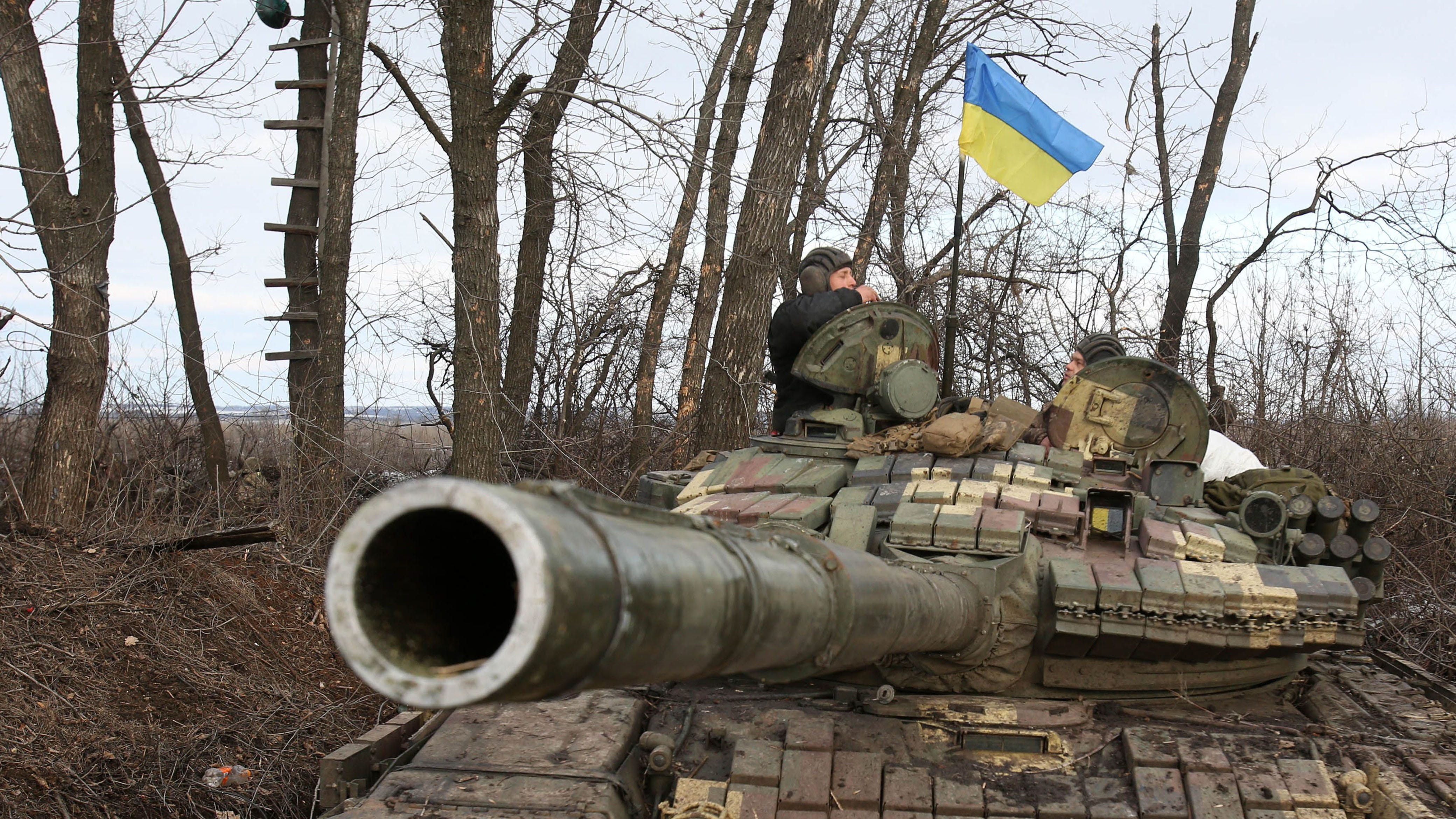
THE LONE GUNMAN & THE SHOT THAT RATTLED NEWSWEEK
This February, Newsweek magazine published an article thoroughly attacking Tucker Carlson and his claims that “up to half” of US military aid being sent to Ukraine was ending up on the black market and in the hands of Mexican drug cartels abroad. In a February episode of "The Tucker Carlson Show" featuring retired U.S. Lt. Col. Daniel Davis, Carlson said:
"They're selling it, and a lot of it ends up with the drug cartels on our border…This is a crime. Our intelligence agencies are fully aware of it. Do you really think they're not profiting from this? Of course, they are. You think the CIA isn't involved? Yes, they are. I can't prove it, but I believe it. Are we supposed to believe they don't know? I know, but they don't? They know. And no one is talking about it."
Newsweek also noted that: “[Carlson] further alleged that the New York Times could ‘get on the web to order Ukrainian weapons’ but again did not provide any direct evidence of where or how those weapons were allegedly being sold.”
Carlson’s claims, though highly speculative and likely exaggerated, are more or less grounded in reality - as we covered previously this year, aid to Ukraine from Western partners has been steadily making its way into the black market since the war began. Early on in the conflict, the United Nations Interregional Crime and Justice Research Institute published a report stating that almost half a million arms given to Ukraine from its allies had been lost or stolen during the initial stages of the Russo-Ukraine war:
“at least 300,000 small arms, most of which were given to Ukraine’s defence by western partners, were stolen or lost between 2013 and 2015, with just 4,000 retrieved since then. According to UNODC (UN Office on Drugs and Crime), most of these small arms entered the wider illicit market in Ukraine and abroad via the Odesa region, sustaining criminal enterprises.”1
A 2022 Department of Defense Inspector General’s report echoed these concerns, citing the logistical difficulties of tracking US weapons in Ukraine and outlining several high-profile instances of weapons caches going missing or stolen, including a plot by a criminal gang who pilfered grenade launchers, machine guns, and over 1,000 rounds of ammunition from Ukrainian arsenals before they were caught.2 The department's inspector general ultimately concluded:
“Personnel did not have the required accountability of the thousands of defense items that they received and transferred."
In spite of all this, Newsweek rated Carlson’s statement as “false,” saying:
“Despite Carlson's assertion that his claim is based on fact, not speculation, neither he nor any independent sources have provided evidence to support the allegations of widespread Ukrainian arms sales.”
This is a bizarre thing to say, given that we know from various US government, UN, and third-party watchdog group reporting that weapons have ended up on the black market in significant quantities - though many outlets like Newsweek have routinely declined to cover such stories, or done so rather quietly when they had to.
A SLEIGHT OF HAND AND THE WINK OF AN EYE
The Newsweek article seems less concerned with the arguably much more important component of the claim - large numbers of US arms being trafficked out of Ukraine stockpiles and sold on the black market - and instead chooses to laser its focus almost exclusively on the “dark web sales” and “Mexican cartel” aspects of Tucker’s claims. Newsweek even goes as far as to pull out ol’ reliable - accusing the claims of being part of a “coordinated effort by Russian disinformation networks to spread false narratives about Ukraine's handling of Western-supplied weapons.” Oh brother.
Even as they try to debunk this rather narrow angle of Carlson’s quote, Newsweek isn’t really completely correct about these aspects of the story, either - a June 2024 report from the Global Initiative Against Transnational Organized Crime (GI-TOC) notes that arms traffickers were likely using dark web (onion) sites and encrypted apps like Telegram to facilitate sales - small fry compared to traditional marketplaces, but still very real:
“…Many commodity transactions around drugs and fraud data have shifted in recent years to the encrypted chat platform Telegram, which allows vendors to avoid using brokers or paying commission.
Telegram channels offering drugs can be seen spraypainted around cities in Ukraine and the CIS states, bypassing issues of establishing legitimacy online.
As yet, the extent to which weapons from the conflict in Ukraine are being sold on Telegram has not been determined – unlike drugs, there are no open channels in Ukraine selling weapons on Telegram. Sales, if they are taking place, will be person to person, using Telegram as a messaging service. But given the scale of arms trafficking revealed using the Encrochat application – more than 900 weapons were seized in related operations – the potential for criminal business using the platform is significant.”3
Additionally, Ukrainian forces have been known to use Telegram for ‘weapons swaps’ before. These deals are not necessarily illegal - they involve Russian arms and equipment abandoned on the battlefield and exchanges between Ukrainian units, not the public - but according to the one report published in the LSE Public Policy Review,
“…captured Russian materiel is exchanged among some Ukrainian units for other military equipment, with swaps negotiated using Telegram, a mobile messaging service. Although no evidence of leakage to the illicit market has been reported, an analyst for Small Arms Survey highlighted that this type of unofficial exchange could undermine stockpile management procedures, potentially increasing the supply of untracked weapons that could later enter the illicit market.”4
These theories seemed to be completely vindicated when as we were writing this, an article published mere hours ago in the Telegraph stated that Spanish police had “uncovered evidence of drug gangs arming themselves with weapons donated by NATO members to Ukrainian forces. The arms are believed to have been advertised for sale and purchased on the dark web.”5
Due to the very nature of organized crime and the anonymity the dark web provides, it makes it difficult to determine how many Ukrainian weapons have ended up being sold in internet marketplaces - unless you buy one yourself. Even then, illicit arms dealers have a multitude of tools and techniques at their disposal to obscure the origins of weapons they sell. But to say categorically that no such activity is taking place online - now, as we know, an outright falsehood - or claiming that such examples are limited is grossly misleading. In all likelihood, it almost certainly is taking place on a significant level, although we can bicker about the exact scale and dollar values ‘til the cows come home.
THE CARTEL CONNECTION
Newsweek also goes on to say, in an effort to dissuade readers from any idea that cartels might purchase from one of the largest illicit arms markets in the world,
“…An analysis from the Kyiv Post dismantled Carlson's claim by examining the types of weapons sent to Ukraine and their likelihood of reaching Mexican cartels. Most military aid in 2024 consisted of artillery systems, Bradley infantry fighting vehicles, and advanced missile systems (HIMARS and ATACMS)—none of which are practical for cartel use.”
Contrast this with another report from the Global Initiative Against Transnational Organized Crime, this time from September 2024:
“But in June 2024, much heavier weapons were seized by Ukrainian law enforcement, including an anti-aircraft gun, a US machine gun and a high-end US automatic rifle carried exclusively by special forces. Significantly, it wasn’t civilians who were collecting discarded weapons and trying to sell them, but two active military personnel, neither of whom had a criminal record, according to a police report seen by the GI-TOC. The most startling seizure was of the 23mm anti-aircraft gun, the Zu-23-2, which was being sold for US $7,500. Who would buy such a weapon remains unclear: its sheer size and capability would probably exclude it from most criminal arsenals, but it could be an option for terrorists or non-state armed groups. The weapon can be mounted on a truck and is capable of downing aircraft or destroying armoured vehicles.”6
“Non-state armed groups?” Like cartels? The same cartels who were found to be using American RPGs and bomb-dropping drones against Mexican army helicopters and told a USA Today reporter they were in the possession of multiple American FGM 148 Javelin infrared-guided missile launchers?
So much for that theory.
Additionally, while the Kyiv Post’s analysis might very well be true for 2024, using a breakdown of military aid from 2020-2023 provided by PBS provides a much fuller picture, and demonstrates that juicy American aid goes well beyond missile defense systems that might not whet the appetite of the cartel:
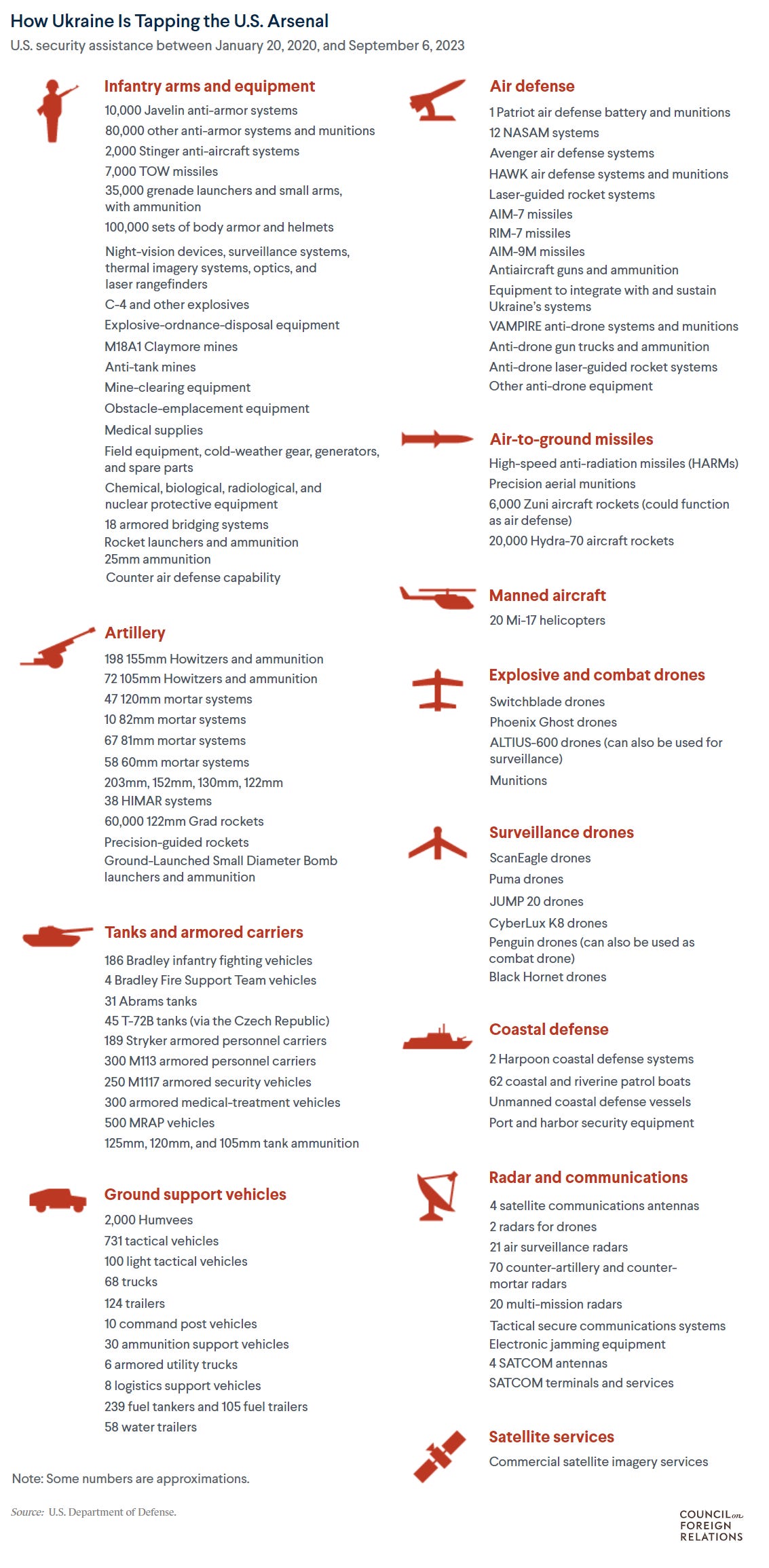
Looking at this much more detailed breakdown, any of this could tempt cartel bosses - and that’s just US aid.
While there has been no documentation suggesting any of these weapons have directly ended up in the hands of the cartels so far, it’s damn near certain that they would or could end up in the hands of Mexican drug cartels - easily the largest and richest organized crime community in the entire globe - looking for high-quality American weapons at bargain-bin prices. Mexican cartels are known to regularly source weapons from European arms dealers, and have been recorded attempting to solicit heavy anti-air weaponry from Russian mobsters.
And we know that other groups abroad are interested in these weapons.
In a 2022 interview with Finnish broadcaster YTE titled “KRP intelligence: Weapons delivered to Ukraine have ended up with criminals in Finland,” the head of the Organized Crime Intelligence Unit for the Finnish national police stated point-blank that black-market Western weapons from Ukraine were already in Finland, and there to stay:
“‘We have a lot of intelligence that criminal organizations are very interested in the weapons supplied to Ukraine and their benefits in the post-war period. The routes, processes and connections required for the smuggling of illegal weapons from Ukraine to Finland are already in place. Finland is home to three of the world's largest motorcycle gangs, which are highly international criminal organizations. One of them is Bandidos MC, which has a branch in every major city in Ukraine. We know that connections are now being warmed up and routes are being modified so that we will be ready in due course…Ukraine has been armed in huge quantities and that's fine. But we will be dealing with these weapons for decades and will pay the price for it here,’ says Ahlgren.”7
Newsweek says it’s impossible, but here’s the smoke; that fire’s around here somewhere.
You don’t have to take my or anyone else’s word for it though - speaking with Ukrainians and Russians themselves, it’s clear that the arms trade is thriving amidst the conflict.
According to one AP article from 2016 titled, “War turns Ukraine into ‘supermarket’ for illegal weapons,”
“Andriy, the arms dealer, fought with the nationalist Right Sector volunteer battalion for more than a year against the separatists. He agreed to discuss the illegal weapons trade on the condition he be identified only by his first name for fear of being arrested. If convicted of illegal weapons sales, he could be sent to prison for five years.
With the worst of the fighting in eastern Ukraine now over, Andriy said a used handgun can be purchased there for as little as $20. ‘But from the east, the road is long and dangerous,’ he said, explaining the significant markup he gets in the capital, Kiev.
The scale of the smuggling is difficult to judge because Ukraine has made all data about the illegal arms trade classified. Ukrainian border guards, however, regularly report thwarting attempts to transport weapons out of the country illegally.
Each week, the security services and police uncover illegal arms caches with Kalashnikovs, explosives and even rocket launchers brought from the combat zone in eastern Ukraine. Transport police almost daily remove passengers from trains for transporting weapons in their baggage. Most are military personnel or members of volunteer battalions that have been fighting on the government side.
Heorhiy Uchaikin, who heads the Ukrainian association of gun owners, estimated that Ukrainians now illegally possess as many as 5 million firearms.
‘Ukraine has turned into a supermarket for illegal weapons,’ he said. ‘In Ukraine, a gun is like shoe polish in a shoe polish factory…’
…But most of the weapons on the black market come from the Ukrainian military and the around 40 volunteer battalions, which for most of the fighting remains outside the military chain of command.
Nadiya Savchenko, a Ukrainian military pilot who fought with a volunteer battalion, blames corrupt military leaders for the flourishing black market.
Savchenko, who became a national hero after being captured and jailed in Russia for two years, alleges that weapons that should have been given to Ukrainian soldiers who were called up to fight have ended up on the black market instead.”8
Well, what do you think - it’s been a minute since 2016. Have the Ukrainians, in the fight of their lives, suddenly got their act together?
UKRAINE’S OPEN SECRET
Despite a wealth of evidence indicating large-scale arms trafficking in Ukraine involving Western aid, major publications insist on towing the line for American foreign policy - even if it costs them the truth. Newsweek says no dark web sales? Tell that to the Spanish cops busting drug gangs with Ukrainian goodie bags filled with lead.
With such a brazen PR-job from a major, multi-million publication such as Newsweek that is supposed to hold itself to a certain standard - and which is partially owned by an evangelical cult movement, as it turns out - one must ask, cui bono? Or in English, “who benefits?” I can certainly think of a few people (one of their names rhymes with “GAYTHEON”).
That no major publication, such as the New York Times, Washington Post, LA Times, or Newsweek have published any articles, none at all (at least to our knowledge) taking a critical lens to these stories and investigated diversion of US/NATO arms in Ukraine to the black market speaks volumes. It seems that the imperative here is less “defending democracy” and more “defending US foreign policy,” much like many of these papers did in the buildup to the 2003 Iraq War. These hacks don’t just have their head in the sand - they’re the Pentagon’s lapdogs, licking boots while the market cashes in.
Regime mouthpieces like these are disgusting publications for a number of reasons, far too numerous to go into here, but their particular, purposeful feigned ignorance of the problems surrounding the ever-controversial war in Ukraine, when it doesn’t serve the state department, is especially heinous.
United Nations Interregional Crime and Justice Research Institute. 2022. The Conflict in Ukraine and Its Impact on Organized Crime and Security. United Nations, November. https://unicri.it/sites/default/files/2022-11/The%20conflict%20in%20Ukraine%20and%20its%20impact%20on%20organized%20crime%20and%20security_0.pdf, 37.
Inspector General of the U.S. Department of Defense. 2022. The DoD’s Accountability of Equipment Provided to Ukraine. U.S. Department of Defense, October 6. https://media.defense.gov/2023/Jul/21/2003265375/-1/-1/1/DODIG-2023-002%20(REDACTED).PDF, 1-10.
Global Initiative Against Transnational Organized Crime. 2024. Smoke on the Horizon: Trends in Arms Trafficking from the Conflict in Ukraine. June. https://globalinitiative.net/wp-content/uploads/2024/06/Smoke-on-the-horizon-trends-in-arms-trafficking-from-the-conflict-in-Ukraine-GI-TOC-June-2024.v3.pdf, 53.
Dudley, Joseph B. 2024. “New Dynamics, New Opportunities: Trends in Organised Crime in Ukraine After Russia’s Invasion.” LSE Public Policy Review, June 25. https://ppr.lse.ac.uk/articles/10.31389/lseppr.94#the-fighting-economy-drugs-guns-and-draft-dodgers, 3-4.
Telegraph. 2025. “Ukraine Risks Becoming Arms Trafficking Hub as War Grinds On.” Yahoo News, April 4. https://www.yahoo.com/news/ukraine-risks-becoming-arms-trafficking-141245988.html.
Global Initiative Against Transnational Organized Crime. 2024. “A New Phase of Arms Trafficking in Ukraine.” September 10. https://globalinitiative.net/analysis/a-new-phase-of-arms-trafficking-in-ukraine/.
Heikel, Kirsi. 2022. “KRP intelligence: Weapons delivered to Ukraine have ended up with criminals in Finland.” Yle Uutiset, October 30. https://yle.fi/a/3-12668870.
Associated Press. 2016. “War Turns Ukraine into ‘Supermarket’ for Illegal Weapons.” AP News, September 14. https://apnews.com/general-news-16ffe979bc2947ce9373079264232406.