

All We Ever Wanted Was Everything
| OPINIONS

IT’S SAFE TO SAY I DON’T KNOW ANYTHING ABOUT WRITING.
I’M NOT A LITERARY SCHOLAR. I don’t hold a degree in philosophy or political theory. I’ve never worked at a prestigious publication. I’ve written things I regret, things I attempted to fashion in the likeness of writers I admired — Hunter S. Thompson being the most obvious victim of my imitation. But oftentimes they come off as a brazenly poor impersonation, like a counterfeit $3 bill with “Slick Willy” Clinton’s face on it, and hence why I despise most of them.
But I do think I’ve observed something real worth writing about: something increasingly visible — faint, but growing louder — in modern conversations about relationships, gender, and more, that disturbs me.
With an increasing frequency, there are “sacred cows” of American political and philosophical discourse; things the average American can not reasonably challenge without risking significant strife and turmoil. I don’t dare to slay them; I have a butter knife when I need a sword.
I do have a couple questions, though.
The questions at hand aren’t even really political; but, nevertheless, they often make their way into the background of various hot-button political and cultural discussions of the 2020s, despite seeming more reminiscent of 19th century Marxist theories on the worker-boss relationship than anything that might be relevant to America today.
And the fundamental question is: where do people factor into these ideas?
To show you what I mean, I want to start with a concept that was originally academic, has since gone mainstream, and now lives in memes, podcasts, and TikTok advice videos: emotional labor.
Going back to its roots, it is widely acknowledged that the concept of “emotional labor” was first introduced by Arlie Russell Hochschild’s 1983 book “The Managed Heart: Commercialization of Human Feeling.”1 In the book, Hochschild introduced “emotional labor” as the management of feelings for professional purposes: workers expected to smile, soothe, and empathize even when exhausted or enraged. This was real work, she argued: invisible, emotionally draining, and often uncompensated.
Hochschild explored how an occupation, like a flight attendant, hotel staff, or nurses, might be expected to be extremely friendly in the everyday discharge of their duties, even if a customer at the other end is being a total asshole.
Over time, though, the term expanded beyond the workplace. It entered conversations about domestic roles — and these examples do have some validity. But something happened along the way: the term migrated from labor to life. From professional, even social expectations, to the private realm of devotion.
To reiterate, my concern isn’t that emotional labor is a totally meaningless idea — I think it may have some utility as a concept — but that when a vocabulary designed to diagnose exploitation in capitalism becomes the language we use for love, it can reshape our relationships into contracts, rather than covenants.
“Emotional labor” is now used to describe planning birthdays, choosing restaurants, being the more emotionally available partner, or simply being a good listener.
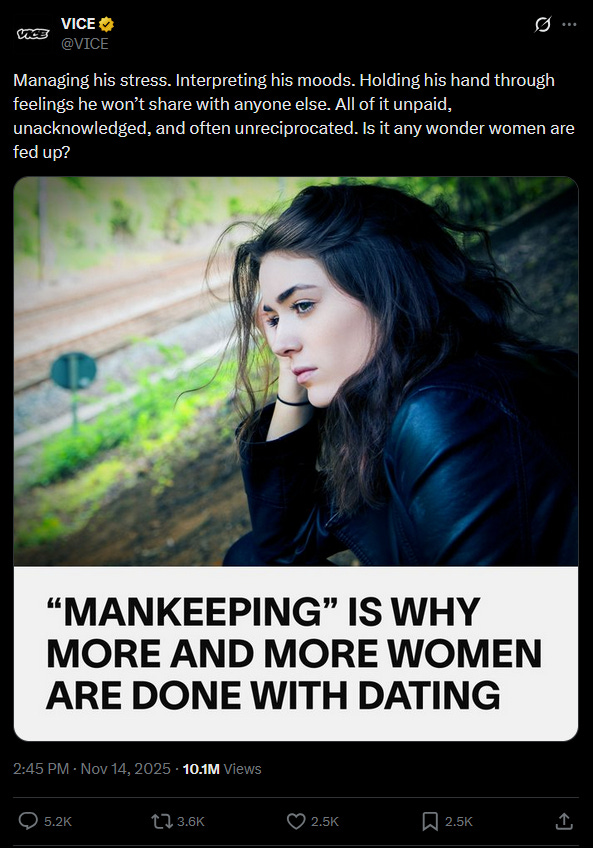
It’s not unreasonable why the phrase caught fire. Millions of women— maybe some men, too — looked up from their marriages and realized they were carrying 80, maybe 90 percent of the mental load while their partner often kindly, often obliviously, coasted.
The exhaustion was not an illusion, the resentment was real.
A name for the thing probably felt like oxygen. But something shifted when the diagnosis hardened into a full-on worldview on how human relationships foundationally function. And it begs the question — is the concept of emotional labor, applied in its current managerial form, still truly a helpful analysis?
As I said, I don’t pretend to have a degree in something like sociology or political science or whatever — but I can’t help but draw the obvious parallels between the line of thought present in emotional labor and that of, say, Karl Marx.
I hear an echo from Marx’s notion of the commodity in Capital — “an external object, a thing which through its qualities satisfies human needs of whatever kind” — which seems to apply here with strange clarity.2
In Marxism (defined very broadly, for our purposes), your view of the history is characterized by an obsession with material conditions and specifically the idea that “societal changes have arisen from material conflicts, such as those between different economic classes,” and as the primary force of social change.3
Predictably, when talk of concepts like surplus labor migrates from the factory floor to the kitchen table, when economic language and frameworks are applied to intimate spaces, it comes with a risk that we start to think of ourselves like commodities — the very thing Marxists accuse capitalism of doing.
The relationship between two lovers becomes something resembling the relationship between a worker and management. Love and devotion are framed as something owed, billed, or compensated, and utterly mundane.
Now, I’m not saying emotional labor is secretly a Marxist plot in disguise; but the starkly transactional perspective of “emotional labor,” as it perceives human relationships, makes it difficult to argue that its second-wave and third-wave feminists progenitors — many of whom were openly influenced by Marxist or materialist feminism — don’t owe at least some part of its heritage to such lines of thinking.
And the fundamental Marxist insistence that all is structural risks draining desire of its spontaneity; everything is material, nothing is human, everything is a transaction.
In its current form, the idea of emotional labor now broadly seeks to describe how women may disproportionately bear the burden of managing feelings, care, and intimacy — viewed as invisible labor under capitalism. Intimacy is work owed, structured by patriarchal systems of power.
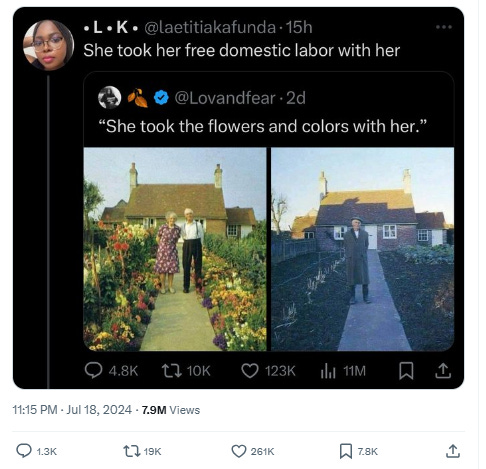
All the impressive academic and economic jargon aside, I don’t think a lot of people really appreciate how antihuman this perspective truly is.
That is not to say that American feminists are going to kill us all. The issue is that, at their roots, they are both managerial analyses, more focused on divisions of labor, exploitation, and productivity, activities better suited to boardrooms than bedrooms. They are concerned with who does what work, when, and if they’re approved to do so.
That is all well and good, but such analyses don’t belong to me or most of you; such things belong to the world of supervisors and calendars. They certainly have no place in human romance.
Maybe, to an extent, it’s a simple matter of projection. I don’t mean to sound dismissive, but I do have a sneaking suspicion that such thought is the byproduct of unhappiness. Say, people who marry who are not truly in love with each other; maybe they even come to fully resent each other, over whatever trigger(s) it might be. When love is absent or has eroded, people reach for managerial tools because that’s all they have left.
Or maybe it is the misguided spokesman of people who have never met someone they could conceivably see as “their other half,” never felt the spark between two personalities locked in evolutionary struggle, a feeling not unlike the caveman who struck the first spark from a flint blade and learned he could control fire.
This article is mostly a philosophical presentation, not a scientific one, but there is a certain amount of empirical evidence to support this assertion: Americans, as well as a lot of our counterparts in the first world, are lonelier than ever, having less sex than ever, and getting married less than ever, seemingly dazed and confused in a brave new world of our own making but strangely alien at the same time.45
It is not totally unexpected that we would apply a similarly cold and calculated approach to relationships in the same way we do the production of motor vehicles or rocketry or even HVAC, or any number of other technological advancements that have taken us far and away from the lowly likes of the Australopithecus, the first hominid who had the audacity to stand upright, and to places like the moon. If we already live in an age of emotional scarcity, maybe it’s natural that we start treating affection or domestic labor like a commodity.
But perhaps it’s also a sign we’ve mistaken labor for meaning.
To draw on a personal example, my grandfather was notorious for leaving all afterlife planning to my grandmother. He refused to speak of funerals, or death, or even life insurance. As the story goes, when he entered old age, my grandmother had to practically force him at gunpoint to draft even a basic will; this was despite the fact that he had just recently experienced a catastrophic heart attack that required a heart transplant.
I don’t pretend to understand exactly why my grandfather was so adverse to thinking about death — perhaps it was because, as a veteran of the Second World War, he had seen so much death and destruction to last a lifetime that he never wanted to even think of those feelings again. Or maybe it was the simple fact that he assumed his wife would outlive him, as is overwhelmingly statistically true of marriages across the globe, and wanted whatever she thought was best.
Regardless of the reasons, he left those labors to my grandmother. But never once have I ever perceived this as “emotional” or “unpaid domestic” labor.
Why? Well, though I’ve never had one, I’m told that marriages are defined by compromise. Humans are finnicky and unpredictable creatures, as you might have noticed. In the case of my grandparents, that meant my grandmother took on the responsibility of afterlife planning, whether that was fair or not. And she did it not because she owed him her labor, but because she loved him.
Equally, he did things in tribute to her.
For example, he was the sole person who, with so much care, maintained the garden of tomato plants in their backyard that she adored so much and reminded her of her childhood, for decades. He did not do that so much for his own benefit, but for hers. They were married for 50+ years, and I have yet to see a couple as in love as they were.
So, with this in mind, to see people approaching relationships armed with concepts like “emotional labor” is most certainly a little alarming.
To see your relationship as one in which you need to prevent your husband (or wife, ostensibly) from extracting surplus labor from you, as if you were the head chairman of the East German State Planning Committee, simply cannot be conducive to a happy relationship. Maybe I’m wrong, but I have some deep reservations about conducting my life in such a way that such deep human experiences become a series of equitable transactions between people who live together. So, maybe, we keep the phrase when it names a genuine injury. And maybe we retreat when it starts turning the person across the table into a coworker.
What else can I say?
https://weld.la.psu.edu/what-is-emotional-labor/
https://www.marxists.org/archive/marx/works/1867-c1/commodity.htm
https://www.ebsco.com/research-starters/history/dialectical-materialism
https://www.gse.harvard.edu/ideas/usable-knowledge/24/10/what-causing-our-epidemic-loneliness-and-how-can-we-fix-it
https://www.newsweek.com/americans-having-less-sex-birth-rate-decline-young-people-2122560